|
IN SHORT
|
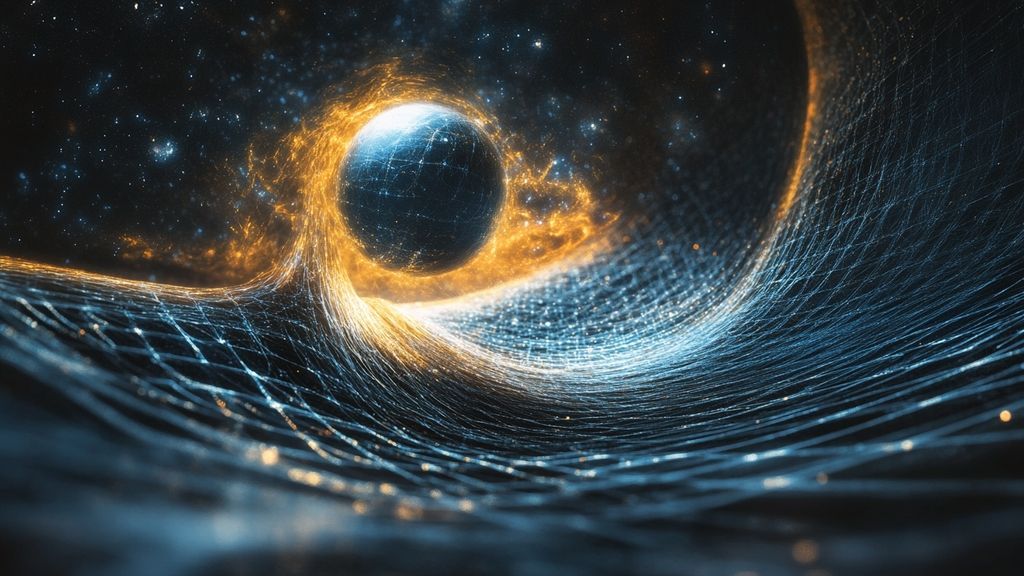
Quantum gravity is a fascinating field of theoretical physics that strives to bridge the gap between two fundamental pillars of our understanding of the universe: quantum mechanics and general relativity. Through various theoretical models, such as loop quantum gravity and string theory, scientists explore the integration of gravity within a quantum framework. These approaches aim to understand how gravity operates at infinitesimal scales, where the usual concepts of spacetime begin to deform and fluctuate. The quest for a unified theory remains a major challenge in physics, promising to reveal yet unexplored aspects of our universe.
Introduction to Theoretical Models of Quantum Gravity
Research on theoretical models of quantum gravity is part of a broad scientific dialogue aimed at reconciling two fundamental pillars of modern physics: quantum mechanics and general relativity. These theories, which function remarkably well in their respective domains, face challenges when seeking to unify them. This article explores the different theoretical approaches that attempt to bridge the infinitely small and the infinitely large, emphasizing loop quantum gravity and string theory among other fascinating concepts.
The Foundations of Quantum Gravity
Quantum gravity emerges as a necessity in our quest for a universal understanding of the laws of the universe. It aims to explore how gravity can be integrated into the framework of quantum theories. Loop quantum gravity, for example, seeks to quantify spacetime itself, raising fundamental questions about the nature of reality. The interaction between general relativity, which describes gravity on a large scale, and quantum mechanics, which governs the behavior of particles on a small scale, constitutes a fertile ground for research.
Loop Quantum Gravity
Loop Quantum Gravity (LQG) is one of the most studied theories in this field. It is based on a canonical approach that applies the principles of quantum mechanics to general relativity. According to this theory, spacetime is made up of small discrete units, or loops, implying that space and time are not continuous but quantized. This model offers a radical vision of the universe, where the fabric of spacetime is both dynamic and granular.
String Theory
Another significant approach in the study of quantum gravity is string theory. This theory suggests that fundamental particles are not points but rather vibrating strands called strings. Within this framework, gravity emerges naturally, integrated with the other fundamental forces of nature. However, this approach remains highly theoretical and faces challenges, including the difficulty of testing its experimental predictions.
Quantum Cosmology
Another relevant domain of quantum gravity is quantum cosmology. This branch explores the implications of the quantization of spacetime on the universe at large scales. Quantum cosmology aims to explain how the universe could have emerged as a quantum entity before evolving into the reality we know today. Models like the big bounce are based on principles of quantum gravity and seek to resolve the mysteries surrounding the origins of the universe.
Challenges and Perspectives
Despite the advances made in the field of quantum gravity, many challenges remain. The complexity of these theoretical models often involves complicated calculations and concepts that escape our intuitive understanding of space and time. The scientific community continues to explore these ideas, seeking experiments that could validate these theories and provide empirical tests. The insatiable curiosity about the origins of the universe and the forces of nature remains a powerful drive for investigation in this field.
For a more comprehensive understanding of the history of physics and its evolution, you can consult this link that traces the major milestones from ancient Greeks to Einstein.
Comparing Quantum Gravity Models
| Model | Characteristics |
| Loop Quantum Gravity | Quantization of spacetime, based on Hamiltonian formulation. |
| String Theory | Integrates a unified description of particles and forces, including gravity. |
| 2D Quantum Gravity | Fluctuation of spacetime, highlighting instability on quantum scales. |
| Spin Foam Models | Considers spacetime as a dynamic foam formed by quantum spins. |
| Post-Quantum Theory | Explores modifications to the laws of gravity at quantum scales. |
Quantum gravity is a fascinating field of theoretical physics that seeks to unify two fundamental pillars of human understanding: quantum mechanics and general relativity. This article explores various theoretical models that address this complexity, particularly emphasizing loop quantum gravity and string theory.
Loop Quantum Gravity
Among the most studied models, loop quantum gravity (LQG) stands out for its innovative approach. This theory is based on the canonical quantization of general relativity and conceptualizes spacetime as a quantum structure formed of small discrete units. By linking both geometry and quantum principles, it provides a valuable framework for addressing gravitational phenomena at subatomic scales.
String Theory
Another influential model in the quest for a unified quantum gravity is string theory. Unlike loop quantum gravity, string theory posits that fundamental particles are not points but rather vibrating strands of energy forming strings. This paradigm adds a new dimension to understanding gravitational interactions, also integrating additional dimensions that might explain phenomena still unexplored in the universe.
Fluctuation of Spacetime
A common feature among several theories of quantum gravity, including loop quantum gravity, is the notion that space and time themselves may fluctuate at the quantum level. This idea challenges traditional concepts of continuity and invariance, thus providing a new perspective on understanding events on a cosmic scale and the very structure of the universe.
Challenges and Perspectives
While significant advances have been made within theoretical models of quantum gravity, several challenges remain. The interactions between these theories and experimental findings in quantum physics and cosmology still need to be explored in greater depth. However, the collaborative effort of researchers in this field offers hope for innovative approaches to solving fundamental questions about the nature of the universe.
- Loop Quantum Gravity – A theoretical framework that seeks to quantify spacetime while reconciling quantum mechanics and general relativity.
- String Theory – A model that encompasses quantum gravity and posits that fundamental particles are vibrating strings.
- Spin Foam Models – Propose descriptions of quantum gravity through discrete structures of spacetime.
- Quantum Cosmology – Studies the implications of quantization of spacetime on cosmology and the origin of the universe.
- Post-Quantum Theory – Explores alternatives to classical gravity by introducing concepts from quantum physics.
- Aether Gravity – An approach that considers spacetime as a dynamic medium filled with quantum aether.
- Two-Dimensional Gravity Theory – A simplified model proposing that spacetime can be described in only two dimensions.
- Derivational Approaches – Includes attempts to derive laws of quantum gravity from fundamental principles.
Introduction to Quantum Gravity Models
Quantum gravity is a fascinating field of theoretical physics that strives to reconcile two major theories: Einstein’s general relativity, which describes gravity on a large scale, and quantum mechanics, which governs the subatomic universe. The theoretical models of quantum gravity, such as loop quantum gravity and string theory, explore the profound implications of this unification, particularly on the nature of spacetime and fundamental interactions. This article provides an overview of the most studied models in this field.
Loop Quantum Gravity
Among the most promising approaches to quantum gravity, loop quantum gravity (LQG) stands out for its method of quantifying spacetime. Unlike other approaches, it offers a discrete structure of space, envisioning it as being comprised of quanta of space, or “loops.” This theory is based on the Hamiltonian approach of general relativity and aims to directly quantify spacetime without necessitating the concept of a traditional gravitational field.
Fundamental Principles
LQG relies on principles such as the non-commutativity of measurement relations, meaning that certain properties of spacetime cannot be measured simultaneously with precision. This raises exciting questions about the nature of space and time themselves, suggesting that at microscopic scales, space and time may be as granular as elementary particles.
String Theory
String theory is another important approach in quantum gravity, proposing that elementary particles are not points but rather one-dimensional vibrating strings. This theory unifies the fundamental forces, including gravity, by describing them as different manifestations of the vibrations of these strings. String theory involves an additional dimension beyond the four familiar dimensions of spacetime we know.
Applications and Implications
The implications of string theory are vast. It opens the door to concepts such as parallel universes and the seriality of dimensions. However, the mathematical complexity and lack of experimental evidence make validation difficult. Nevertheless, it remains one of the most explored approaches to address the challenges related to quantum gravity.
Quantum Cosmology
Another essential aspect of quantum gravity models is quantum cosmology. This branch studies the universe at its beginnings, where quantum effects may dominate the observed phenomena. By integrating quantum gravity within the cosmological framework, models like the Hartle-Hawking model propose scenarios for the creation of the universe without an initial singularity. These approaches challenge our traditional perceptions of time and space.
Difficulties and Challenges
Although these models offer promising leads, they face numerous challenges. Confrontation with experimental data remains a crucial issue. Research in quantum gravity must continue to evolve to establish experimental tests that could validate or refute these theories. By striving to unify quantum mechanics and general relativity, physicists are paving the way for new understandings of the very structure of the universe itself.
FAQ on Theoretical Models of Quantum Gravity
What is quantum gravity? Quantum gravity is a branch of theoretical physics that seeks to unify quantum mechanics and general relativity, two pillars of our understanding of the universe.
Why is it important to study quantum gravity? The study of quantum gravity is essential for understanding the fundamental interactions of the universe, especially at very small scales where gravity and quantum mechanics intersect.
What are the main models of quantum gravity? The two most studied models are loop quantum gravity and string theory, each having different approaches and implications.
How does loop quantum gravity work? Loop quantum gravity relies on the canonical quantization of general relativity, using a Hamiltonian approach to describe the properties of spacetime.
What practical applications can quantum gravity have? Although quantum gravity is still largely theoretical, its discoveries could potentially influence the understanding of astrophysical phenomena, such as black holes or cosmology.
Is string theory an answer to quantum gravity? String theory seeks to unify all fundamental forces of nature, including gravity, by modeling elementary particles as vibrating strings rather than points.
Are fluctuations of spacetime a consequence of quantum gravity? Yes, in many approaches, such as loop quantum gravity, it is proposed that space and time themselves can fluctuate at quantum scales, challenging our classical understanding of these concepts.