|
IN BRIEF
|
From the rudimentary calculations of antiquity to today’s digital age, the history of computing is a fascinating journey through time. This discipline, which emerged from a combination of mathematics and physics, has seen visionaries like Charles Babbage conceptualize machines capable of transforming our way of manipulating information. From the first commercial computer in 1951 to the democratization of microcomputers in the 1980s, each innovation has opened new perspectives and reinvented our relationship with technology. Let’s dive together into this captivating adventure, which reveals how computing has shaped our daily lives and continues to redefine our future.
The history of computing is a fascinating adventure that transports us from the first calculations of antiquity to the current digital age. This journey through time highlights spectacular innovations, notable personalities, and revolutionary ideas that have shaped this field and continue to fuel our daily lives. Let’s explore together this incredible path that has allowed computing to become one of the cornerstones of our modern era.
The Beginnings of Computing
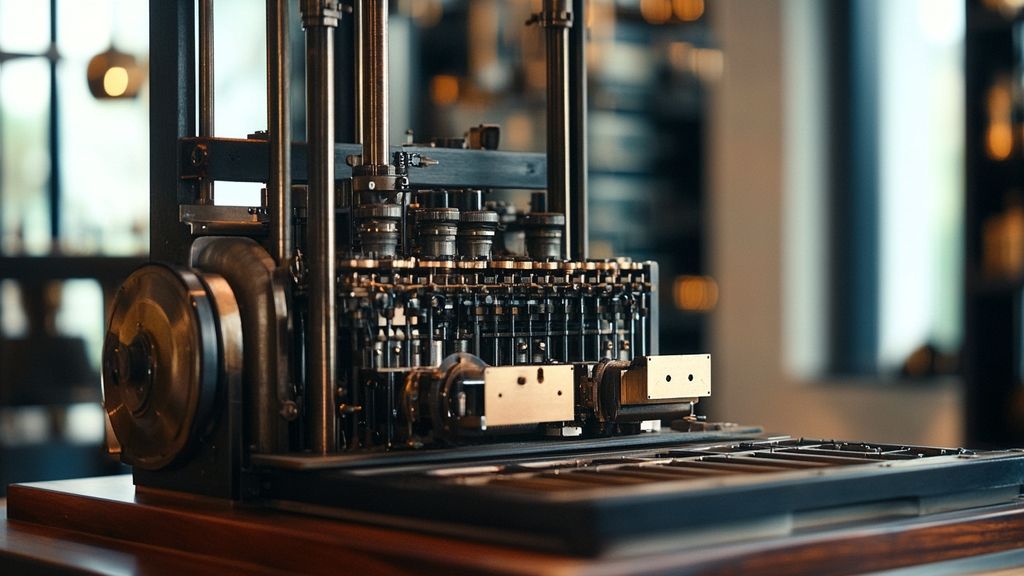
The roots of computing go back well before the modern era, tracing back to centuries of innovations in mathematics and physics. Since antiquity, the first civilizations used tools such as the abacus to perform calculations. Then, during the 19th century, Charles Babbage conceptualized what is often considered the first programmable calculator, the analytical machine. This bold invention laid the foundations of what we know today as computing.
The Rise of Automata in the 19th Century
As we enter the 19th century, the rise of automata marked a key milestone. The invention of the Jacquard loom by Joseph Marie Jacquard in 1801 introduced the concept of programming through punched cards. This principle inspired future innovations, and Babbage built upon this idea for his own machine. Thus, the automation of work paved the way for methods of calculation and data storage that would be crucial three centuries later.
Modern Computing and Early Machines
It was in the 1930s that modern computing began to take shape. In 1936, mathematician Alan Turing proposed the notion of the “Turing machine,” a theoretical concept that laid the groundwork for computing as a discipline. Subsequently, the University of Pennsylvania developed the ENIAC, the first general-purpose electronic computer, which was completed in 1945. The following years saw the emergence of other machines, including the UNIVAC in 1951, the first commercial computer.
From the 1960s to the 1980s: The Alert of Programming Languages
The 1960s were marked by the development of new programming languages, such as FORTRAN and COBOL. These innovations allowed developers to communicate more effectively with machines. Meanwhile, the emergence of the Intel 4004 in 1971, the first microprocessor, transformed the technological landscape. Prototypes of microcomputers began to appear on the market, giving birth to a new era of personal computing.
The Rise of Personal Computers
With the launch of the IBM PC in 1981, a new chapter in the history of computing opened. Personal computers became accessible to the general public, revolutionizing the way people interacted with the digital world. This decade also saw the rise of operating systems, including the famous MS-DOS, which served as the foundation for many applications.
The Advances of the Internet Era
The late 1990s brought with them the explosion of the Internet. This global network opened the doors to a new world of opportunities, allowing instant communication and information sharing on an unprecedented scale. The advent of the World Wide Web also enabled the emergence of many businesses, creating upheaval in several sectors and contributing to shaping the “digital revolution.”
The Challenges and Future of Computing
In today’s world, advances such as artificial intelligence elicit excitement but also raise ethical questions. Many experts, some advocating for responsible use of these technologies, wonder how AI will influence our daily lives. The need to discuss the societal impact of new technologies is more relevant than ever. For a deeper exploration of this issue, you can visit this link on the mathematical theorems that have had a significant impact or discover the beauty and complexity of fractals that also illustrate fundamental concepts in computing. Not to mention the importance of prime numbers in the development of cryptography and online security.
It is undeniable that the history of computing is intrinsically linked to that of humanity, marked by unprecedented discoveries. Looking to the future, we can be assured that the field will continue to evolve, bringing its share of innovations and questions about how they will be integrated into our daily lives.
The Evolution of Computing Inventions
| Date | Key Invention |
| 1801 | Invention of the loom by Joseph Marie Jacquard, the first programmable machine. |
| 1834 | Charles Babbage designs the analytical machine, foreshadowing the modern computer. |
| 1936 | Alan Turing proposes the concept of the Turing machine, foundation of modern computing. |
| 1951 | Launch of the UNIAC, first marketed computer. |
| 1962 | The term computing is created, merging information and automatic computing. |
| 1971 | Launch of the Intel 4004, first microprocessor. |
| 1981 | IBM introduces the PC, democratizing access to computing. |
| 1991 | Release of the Web, revolutionizing access to information. |
| 2004 | Appearance of Artificial Intelligence in homes with voice assistants. |
| Present | Debates on the ethics of AI and its societal impact. |
Whether you are a technology enthusiast or simply curious about the modern world, the history of computing is a fascinating epic that deserves to be explored. From simple calculations to the era of artificial intelligences, the evolution of this discipline has profoundly changed our daily lives. Let’s dive together into the intricacies of computing, from its beginnings to today.
The Beginnings: Mathematical Foundations
The roots of computing are deeply embedded in mathematics and physics, long before the very term computing emerged. Ancient civilizations already used tools to perform calculations, but it was in the 19th century that the first automated machines began to appear. Charles Babbage, often referred to as the father of computing, conceptualized the analytical machine, a precursor to the modern computer.
The 20th Century: The Era of Calculators
The first half of the 20th century marks a decisive turning point with the advent of the first electronic calculators. In 1936, Alan Turing laid the foundations of computation theory, revolutionizing what machines were capable of doing. In 1951, the UNIVAC, the first commercial computer, was born, making computing accessible to a wider audience.
The Explosion of Microcomputing
The 1980s witnessed a true computing revolution thanks to the emergence of microcomputers. The arrival of the IBM PC and the Commodore 64 created unprecedented excitement. At this time, computing became an essential tool for businesses, but also for the general public. The first programming languages like BASIC became popular, paving the way for a new generation of developers.
From Digital to Artificial Intelligence
Over the decades, computing has evolved to give birth to advanced technologies. Artificial intelligence, now on everyone’s lips, represents the pinnacle of this evolution. Complex algorithms, recommendation systems, and even voice assistants all rely on the foundations laid by our ancestors in computing. Discover how mathematics combined with technology shapes our future at this link and delve into the fascinating concepts of fractals at these links.
On the Horizon: The Future of Computing
Looking to the future, computing continues to reinvent itself. Technologies like blockchain, the Internet of Things, and quantum computers promise to further transform our relationship with technology. Computing is not just a series of machines, but a true cultural revolution that influences all aspects of our society.
The history of computing is fascinating and complex, rooted in centuries of technological evolution, from simple addition to the power of modern computers. This article delves into the major milestones of this discipline, which has revolutionized the way we communicate, learn, and work. By exploring the predecessors, major advances, and contemporary challenges, we highlight the personalities and inventions that have shaped the digital world as we know it today.
The Origins of Computing
Computing does not emerge from a void. Its roots trace back to mathematical and mechanical inventions of antiquity. The first calculations were made using counting sticks or balls on an abacus. Over the centuries, numbers and algorithms gradually emerged as indispensable tools for mathematicians and astronomers.
In the early 19th century, British inventor Charles Babbage conceptualized the first programmable machine, known as the analytical machine. Although it was never completed, this groundbreaking idea laid the groundwork for what we today call the modern computer.
The 20th Century: The Emergence of Modern Computing
The real turning point occurred in the 20th century, with the arrival of the first automata and calculators. In 1943, the ENIAC machine was created, marking the beginning of the era of electronic computers. Capable of performing millions of calculations in a second, it laid the foundations of modern computing.
Then came Intel’s first microprocessor, the 4004, in 1971. This expanded its use, closely followed by the commercialization of the first personal computer in 1981 by IBM. Here, computing marked the transition from a technological niche to something absolutely connected to daily life.
The 2000s: The Digital Revolution
The 2000s mark a significant leap in the integration of computing into our daily lives. With the advent of the Internet, access to information becomes instantaneous. Giants like Google, Facebook, and Amazon emerge, transforming how we consume and interact. Social networks establish themselves as a new form of communication, reducing distances between people to a simple connection.
This era is also marked by an explosion of mobile technologies, making information accessible in the palm of our hands. Smartphones and tablets become ubiquitous tools, integrating applications for nearly every need. This omnipresence brings ethical and societal debates around data protection and the impact of technologies on our privacy.
Contemporary Challenges: Towards Ethical Computing
At a crossroads, computing faces challenges that require serious ethical reflection. The rise of artificial intelligence, with its colossal impacts on employment and personal life, raises numerous questions. The importance of an ethical approach to emerging technologies has never been more urgent. Discussions on algorithmic fairness and system transparency become essential topics to consider for a serene future.
In summary, the history of computing is an incredible journey, rooted in innovation but also accompanied by crucial challenges that require public discourse. The next step in this exciting adventure depends on our ability to balance technology and ethics to build a better world.
FAQ on the History of Computing
Q: When did the history of computing really begin?
A: The history of computing began long before the modern discipline took shape and is often linked to advances in mathematics and physics.
Q: Who is considered the father of computing?
A: Charles Babbage is often referred to as the “father” of computing for his contributions to the design of the first programmable machines.
Q: What major advances occurred in the 19th century regarding computing?
A: In the 19th century, inventions such as the loom of Joseph Marie Jacquard (1801) laid the groundwork for programming with the idea of mechanisms that could be controlled sequentially.
Q: What was the first commercial computer?
A: The first commercial computer was the UNIAC, marketed in 1951.
Q: When was the term “computing” created?
A: The term “computing” was coined in 1962, by Philippe Dreyfus, by combining the words information and automatic.
Q: How has computing evolved over the decades?
A: The evolution of computing has been marked by technological leaps, such as the creation of the first microprocessor, the Intel 4004, followed by various prototypes of microcomputers in the 1970s.
Q: What is the importance of programming theories in the history of computing?
A: Programming theories are essential as they have enabled the development of languages and techniques for writing programs, which has propelled modern computing.