|
IN BRIEF
|
Geometry is a field of mathematics that allows one to explore shapes, spaces, and the relationships that characterize them. For children, acquiring fundamental concepts in geometry is essential, as it helps them understand and interact with their environment. Through fun activities such as identifying different geometric shapes or observing symmetries, young learners learn to recognize and analyze the objects around them. This early introduction to geometry fosters the development of their critical thinking and spatial reasoning skills, while making mathematics accessible and enjoyable.
Geometry is an essential branch of mathematics that helps children understand and explore the world around them. With adapted fundamental concepts, young learners can begin to recognize and name geometric shapes, comprehend spatial relationships, and develop logical reasoning skills from an early age. This article provides an overview of basic concepts as well as fun methods for teaching geometry to children.
Basic Geometric Shapes
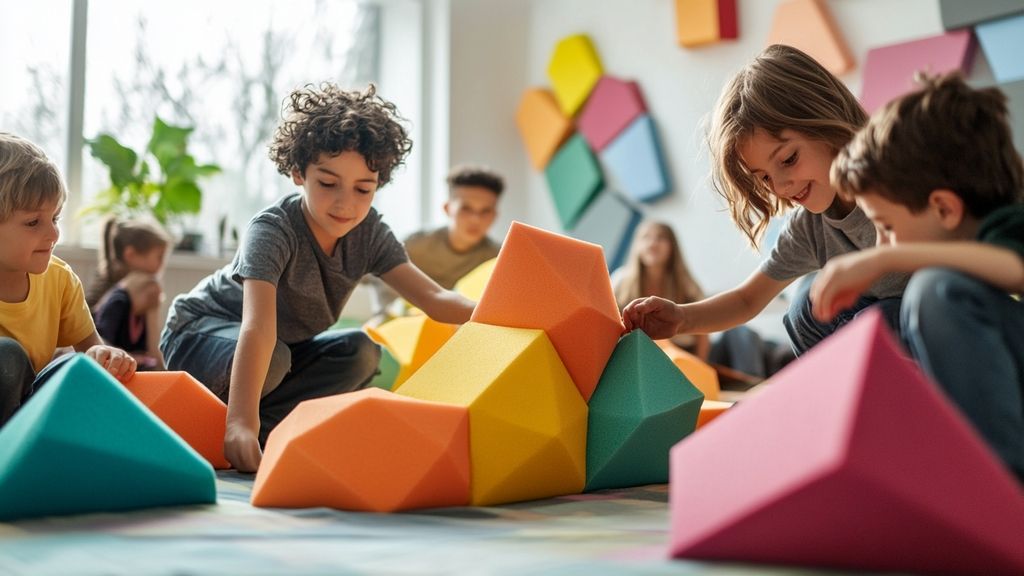
Children begin by discovering fundamental geometric shapes such as squares, rectangles, circles, and triangles. It is important for these shapes to be recognized not only visually but also through games and activities. For example, educators can introduce children to building these shapes through block games or drawings, thus allowing for tactile and visual contact with geometric figures.
Properties of Shapes
Once children are familiar with the shapes, it is useful to teach them the properties associated with each one. This includes understanding sides, angles, and symmetries. Through practical activities, such as creating shapes using folded paper or drawing symmetrical figures, children can explore these concepts in a concrete manner.
Measurement Concepts
In parallel, the introduction of measurement concepts is crucial. Children can learn to measure lengths using rulers, understand the area of basic shapes through cutting and gluing activities, or explore the concept of volume using containers of different shapes. These practical experiences enrich their understanding of geometry by linking theory with practice.
Exploration of Spatial Relationships
Geometry is not limited to recognizing shapes; it also encompasses spatial relationships. Through activities like sorting objects based on different characteristics (shape, size, color), children learn to establish classifications and comparisons between objects. This learning promotes essential cognitive development that extends beyond mathematics.
Introduction to Symmetry
Another fundamental aspect of geometry is symmetry. Children can explore this concept by observing everyday objects, creating symmetrical patterns, or reflecting on works of art. Through artistic activities focused on axial symmetry, young learners can appreciate this notion while having fun.
Games and Fun Activities
Learning geometry can also be enriched through games. For example, board games that involve moving on shapes or orientation courses aim to reinforce spatial knowledge. Geometric puzzles or treasure hunts based on geometric clues create a dynamic and enjoyable interaction between children and mathematical concepts.
By integrating these activities into children’s daily lives, we enhance their ability to manipulate shapes and establish connections with geometric notions. By developing a solid understanding of the basic principles, children will be better prepared to navigate more complex mathematical concepts as they progress in their schooling.
For further explorations related to geometry and mathematics, you can consult resources such as the history of physics or mathematical theorems.
| Concepts | Description |
| Geometric Shapes | Identification and recognition of squares, circles, triangles, and rectangles. |
| Symmetry | Understanding the notion of axial symmetry through creative activities. |
| Measurements | Learning about lengths and angles with simple tools. |
| Comparison | Evaluating shapes and sizes through games. |
| Graphism | Introduction to graphomotor skills for representing shapes. |
| Classes of Objects | Sorting based on criteria such as shape, color, and size. |
| Use of Games | Incorporating educational games to reinforce geometric concepts. |
| Creation | Designing 3D models to visualize geometric shapes. |
| Spatial Exploration | Observing the environment to link geometry to reality. |
Geometry is a fascinating field of mathematics that allows children to discover and understand the world around them. By learning the basics of geometry, they develop essential skills such as shape recognition, spatial relationships, and even problem-solving. This article explores the fundamental notions of geometry and offers activities to reinforce these concepts in young learners.
Introduction to Geometric Shapes
From a young age, children are exposed to different geometric shapes such as squares, triangles, circles, and rectangles. This familiarization can be reinforced through playful games and classification activities. For example, asking children to name objects in their environment that match these shapes can enrich their understanding.
Spatial Relationships
Understanding spatial relationships is another key skill. Through activities such as stacking blocks or drawing geometric figures, children learn notions like left, right, front, and back. These notions guide them to orient themselves correctly in space.
Basics of Symmetry
Symmetry is an important concept in geometry. Children can be introduced to this idea through practical activities where they must fold paper to create symmetrical patterns. Discovering axial symmetry by observing their own reflection is also an engaging way to learn this notion.
Using Geometry in Daily Life
Integrating geometry into children’s daily activities is essential. Whether cooking, gardening, or playing board games, children can be encouraged to identify shapes and count sides. This allows them to see the relevance of geometric concepts in their everyday lives.
Practical Exercises and Educational Games
Practical exercises can help cement this knowledge. For example, construction games like Lego allow exploration of three-dimensional shapes and understanding concepts of distance and volume. Manipulating clay to create shapes is also an enriching activity that stimulates creativity while reinforcing geometric foundations.
It is crucial to instill in children a fundamental understanding of geometry that will not only assist them in their academic journey but also develop their critical thinking and observational skills. By combining theoretical and practical learning, children can appreciate the beauty of geometry from a young age.
- Geometric Shapes : Recognize squares, rectangles, circles and triangles.
- Spatial Relationships : Understand position and distances between objects.
- Vocabulary : Learn terms such as point, line, angle.
- Symmetry : Identify and create symmetrical patterns.
- Measurement : Introduction to concepts of length and width.
- Classification : Sort objects based on their shape, size, or color.
- Construction : Use materials to manufacture geometric shapes.
- Graphism : Develop graphomotor skills through drawing shapes.
- Observation : Compare the dimensions and properties of objects.
- Educational Games : Use games to learn geometric concepts.
Introduction to Fundamental Concepts of Geometry
Geometry provides an essential foundation for developing logical thinking and spatial understanding in children. Through playful activities and visual explorations, it is possible to familiarize young minds with geometric shapes, the relationships between different objects, and the fundamental concepts of space. This guide offers various strategies for introducing children to geometric principles while having fun.
Discovering Geometric Shapes
It is crucial to introduce children to different geometric shapes from an early age. In kindergarten, children can learn basic shapes like the square, rectangle, circle, and triangle. Through observation and manipulation activities, they can discover how these shapes appear in their everyday environment. For example, by observing everyday objects, such as windows or traffic signs, they develop their ability to identify shapes.
Properties of Shapes
Once children are aware of the shapes, it is crucial to explore the properties of each one. This includes understanding sides, angles, and symmetries. This approach can be facilitated through games where children sort shapes based on different criteria, for example, classifying them by the number of sides or spotting straight and curved ones. Such activities allow them to learn to compare and distinguish different types of shapes.
Introduction to Measurement Concepts
Measurement concepts are also fundamental in geometry. Children can learn to measure playfully using simple tools like a ruler or tape measure. They can explore length and width concepts through block assembly games, construction activities, or line tracing. By measuring objects, they start to understand the importance of scale and proportion.
Learning Through Play
Play is a powerful tool for teaching geometric concepts. Activities like Duplo or puzzles promote not only the manipulation of shapes but also the exploration of dimensionality. Board games that involve moving on grids or boards can also help children understand spatial relationships and develop their sense of direction.
Visibility of Geometric Concepts
To strengthen learning, it is beneficial to make geometric concepts visible. This can include using drawings, models, or even artistic creations. Children can create works of art using shape makers for geometric shapes, which helps them visualize and understand concepts like symmetry. These artistic projects also enhance their creativity while solidifying their knowledge.
Encouraging Exploration
Finally, it is important to encourage children to explore and ask questions about the world around them. Inviting children to observe their environment while identifying geometric shapes or calculating distances between objects reinforces their learning and understanding. This active engagement stimulates their curiosity and prompts them to think more deeply about geometric concepts.
FAQ: Fundamental Concepts of Geometry for Children
Q: Why is it important to familiarize children with geometric shapes? Children gain a better understanding of the principles of geometry when they explore shapes and spatial relationships in their environment.
Q: What are the basic geometric shapes that children should learn? Students start by exploring shapes such as squares, rectangles, circles, and triangles.
Q: How can children learn geometry playfully? By playing to recognize colors, compare quantities, and assemble or stack objects, children interact with geometry in a fun way.
Q: What activities can help young children develop skills in geometry? Activities such as observing, sorting, and comparing shapes help children distinguish various criteria, such as shape and length.
Q: What role does graphomotor skills play in learning geometry for young children? Graphomotor skills enable children to graphically represent geometric shapes, thereby reinforcing their understanding of the characteristics of these shapes.
Q: What basic notions in geometry should children learn? They should familiarize themselves with fundamental elements such as points, lines, angles, and circles.
Q: How can skills in geometry be reinvested in creative activities? Children can use their knowledge of symmetry, for example, by reproducing patterns or creating artwork based on geometric shapes.