|
IN BRIEF
|
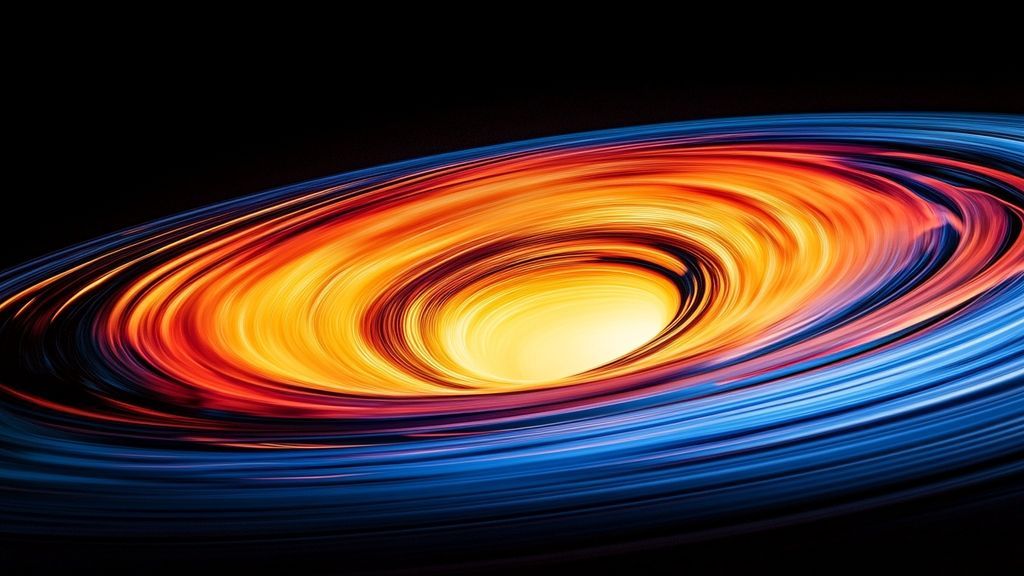
The physics of accretion disks is a captivating field of astrophysics, centered on the fascinating structures that form around black holes. These disks, made up of gas and dust in orbit, play a crucial role in the dynamics of celestial objects. When a star or other material is drawn toward a black hole, it begins to spiral in, creating a massive accumulation of matter that generates intense radiation. The study of accretion disks reveals not only extreme physical phenomena but also sheds light on our understanding of the processes of matter absorption and the jets that result. This research is essential for deciphering the properties and behaviors of black holes, thereby illuminating the mysteries of our universe.
Accretion disks surround some of the most fascinating and mysterious objects in the universe, namely black holes. These astrophysical structures form when matter, often in the form of gas and dust, orbits around a black hole, creating a unique phenomenon of energy conversion. In this detailed article, we will explore the composition, dynamics, and observation of accretion disks, while highlighting their crucial role in understanding black holes.
What is an accretion disk?
An accretion disk is defined as a formation of matter that rotates around a celestial object, such as a black hole, due to the intense gravitational force it exerts. This orbiting matter can come from a companion star in a binary system or result from the dispersion of a nebula. The rotation of this matter creates a flat and often spiral structure, where material is continually drawn toward the center, where the black hole is located.
Composition and dynamics of accretion disks
Accretion disks are primarily composed of hot gas and dust, which are rotating at very high speeds. As the matter approaches the black hole, gravitational forces become stronger. This leads to a conversion of gravitational potential energy into kinetic energy, and then into heat, which contributes to emitting radiation at different wavelengths, including X-rays.
Accretion disks around supermassive black holes
Accretion disks are not limited to stellar black holes; they are also present around supermassive black holes at the centers of galaxies. These disks are much larger and contain massive amounts of matter. They play a fundamental role in the growth of black holes, fueling their expansion over time. The intense gravity of these objects leads to jets of matter that escape at speeds close to that of light, creating detectable radiation over vast distances.
Observations and scientific implications
Observations of accretion disks have significantly advanced thanks to space missions like the Hubble telescope. When these disks are observed from specific angles, some of the material moves towards the observer, making the analysis more complex but also more fascinating. The radiation emitted by these disks provides valuable clues about the physical processes occurring near black holes.
Polarized light and accretion disks
A captivating aspect of accretion disks is their ability to emit polarized light, a feature often associated with material ejection processes. This polarization can help astronomers determine essential aspects, such as the magnetic field around the black hole and the dynamics of the disk. Each observed phenomenon enriches our understanding of black holes and their environment.
Accretion disks are essential components for understanding the behavior and evolution of black holes. Through the study of their physics and observation, scientists illuminate the mysteries of the universe, while inspiring interest in astronomy and future work in this exciting field.
Comparison of the characteristics of accretion disks around black holes
| Characteristic | Description |
| Composition | Accretion disks are made up of rotating gas and dust. |
| Rotation | The movement of the material is influenced by the intense gravity of the central black hole. |
| Light emission | They emit luminous radiation, often polarized, due to the heat generated. |
| Orientation | The tilt of the disk relative to the observer affects the perception of the light flow. |
| Material jets | Jets of plasma can be emitted perpendicular to the accretion disk. |
| Contribution to growth | They fuel the black hole, thus increasing its mass over time. |
| Observation | Accretion disks are detected through their light and X-ray radiation. |
Accretion disks are fascinating structures that form around black holes when matter falls into their gravitational well. Understanding the physics of these disks allows us to explore incredible astrophysical phenomena and uncover the mysteries of the universe. This article will dive into the details of these accretion disks, their formation, composition, and role in the behavior of black holes.
What is an accretion disk?
An accretion disk is made up of gas, dust, and other elements in orbit around a central celestial object, often a supermassive black hole or a young star. This matter gradually falls toward the center due to the intense gravitational force exerted by the object. As the material approaches this central body, it accelerates, generating extreme temperatures and pressures that can produce electromagnetic radiation.
Accretion disks and relativity
One of the astonishing characteristics of accretion disks is the effect of general relativity on their behavior. When the disk is viewed from a particular angle, some materials move toward the observer, increasing the brightness of that region. Additionally, near a black hole where speeds approach that of light, the light propagation time can change, creating unique optical effects that allow us to closely study the phenomenon of black holes.
The light emission from accretion disks
Accretion disks can emit significant amounts of light, often ranked among the brightest sources in the universe. For example, the accretion disk of the central black hole of our Milky Way releases polarized light, often associated with X-ray radiation and radiation at other wavelengths. This emission can be observed through specialized telescopes, allowing astrophysicists to extract data about the structure and behavior of the disks.
The implications of accretion disks
Research on accretion disks offers incredible insights into the mechanisms that stabilize or fuel black holes. The dynamics of these disks may also influence star formation and other galactic entities. By studying how these disks interact with their environment, scientists hope to better understand the evolution of galaxies and the distribution of dark matter in the universe.
- Accretion disk: structure formed by matter in orbit around a celestial body.
- Black hole: region of space with an intense gravitational field.
- Tilted: some disks are observed with a particular tilt angle.
- Speed of light: influence of the jet on the observation of disks.
- Material flow: a part of the material moves toward the observer.
- Light emission: disks often emit polarized radiation.
- Observation of black holes: detected in binary or supermassive systems.
- Role of gas and dust: main constituents of accretion disks.
- Curiosities: origin of the materials drawn in by black holes.
- Mysteries: inquiry about what lies behind a black hole.
Introduction to the physics of accretion disks
The physics of accretion disks is a fascinating field that studies astrophysical structures formed by rotating matter around celestial bodies, such as black holes. These disks play a crucial role in the dynamics of systems involving compact objects and allow the observation of various astrophysical phenomena. This article examines the composition, functioning, and importance of accretion disks, particularly their interaction with supermassive and stellar black holes.
What is an accretion disk?
An accretion disk is a rotating structure made up of gas, dust, and other materials, orbiting around a central object. In the case of black holes, this matter often comes from binary systems, where a companion star transfers its matter to the black hole through intense gravitational flow. Accretion disks are characterized by their complex dynamics involving gravitational forces, viscosity, and heat transfers.
Accretion disks around supermassive black holes
Supermassive black holes, found at the centers of galaxies, are surrounded by particularly massive and luminous accretion disks. The matter that orbits here undergoes compression and generates powerful radiation, often observed in X-ray wavelengths and visible light. These disks are crucial for understanding the growth of black holes and the evolution of galaxies.
The dynamics of accretion disks
The dynamics within an accretion disk is influenced by several factors. When a disk is viewed from a particular angle, Doppler effects can cause a shift in the wavelengths of light emitted by the material moving toward the observer, creating a fascinating phenomenon of polarized light. Moreover, the speed at which matter moves can approach that of light, causing relativistic effects that complicate the analysis of disks.
The interaction between matter and the black hole
As matter accumulates in the accretion disk, it eventually gets drawn into the black hole, causing a phenomenon of gravitational fall. This process generates intense heat and high radiation, making these systems very luminous in the cosmos. Scientists study this interaction to better understand the evolution of the disks and their role in the lifecycle of galaxies.
The observation of accretion disks
Modern astrophysical observation techniques, such as the use of powerful telescopes, allow for the detection and analysis of accretion disks. Through these tools, astronomers can study the physical properties of disks, measuring their size, mass, and temperature, thereby contributing to a deeper understanding of the mechanisms at work in these complex layers of the universe.
Applications of research on accretion disks
Research on accretion disks has implications that extend far beyond the mere study of black holes. By analyzing these structures, scientists discover new astrophysical dynamics, providing keys to understanding galaxy formation, star creation, and cosmic evolution. The conclusions drawn from these studies can also influence our understanding of the fundamental laws of physics and the origins of the universe itself.