|
IN BRIEF
|
Mathematics, as a rigorous and universal discipline, finds a surprising resonance within religions and beliefs. Since antiquity, these two fields, often perceived as opposites, have interacted in complex ways. Systems of belief can draw on mathematical concepts to express abstract ideas about the existence of God or the order of the cosmos. Furthermore, thinkers like Gödel have attempted to shed mathematical light on metaphysical questions, creating a bridge between spirituality and rationality. In this exploration, it becomes essential to consider how the materialities of mathematics can enrich our understanding of religious traditions and the questions that animate the human mind.
Mathematics and spirituality maintain a complex and fascinating relationship. In many religious traditions, mathematics is seen as a means to explore the mysteries of the universe and to draw closer to the divine. This article examines how different religious beliefs incorporate mathematical concepts into their philosophy and practices, while addressing debates about the existence of God through the lens of mathematics.
The importance of mathematics in religious thought
Over the centuries, mathematics has played a crucial role in shaping religious thought. In antiquity, many cultures, including Greek and Mesopotamian, used mathematics to calculate astronomical cycles, which were often linked to religious celebrations. For example, the mathematicians of Babylon developed methods to predict eclipses, thus integrating mathematical concepts into their understanding of the cosmos, often seen as a reflection of divine will.
Religious approaches to mathematics
Diverse religious traditions have sought to connect mathematical concepts with their beliefs. For example, in the Islamic tradition, mathematics has been regarded as a way to understand God’s creation. The emphasis on rigor and precision in calculations reflects a particular respect for the divine harmony that is believed to govern the universe. Muslim scholars played a key role in preserving and advancing mathematics, influencing centuries of scientific developments.
Mathematics as a tool for reflection on the existence of God
The question of the existence of God has often been approached through mathematical arguments. One of the most famous is the ontological proof, which uses concepts from logic and mathematics to justify the existence of a supreme being. This philosophical debate highlights the deep connection between mathematics and beliefs, thus fueling exciting discussions about the very nature of reality.
Mathematics and the beauty of the world
The field of fractals and chaos theory is a perfect example. These mathematical concepts, often perceived as abstract, reveal the beauty and complexity of the world around us. In some religious traditions, coming to understand such complex structures is regarded as a pathway to a deeper understanding of the divine. The patterns of a mathematician like Benoît Mandelbrot can even be seen as a reflection of the motifs created by God in nature.
Theorems that have changed our perception
Mathematical theorems have had a significant impact on various fields, even within spirituality. Discoveries such as those concerning prime numbers or algebraic equations have transformed our understanding of the world. In this regard, it is interesting to consult resources such as the importance of prime numbers and the mathematical theorems that have changed the world, which demonstrate how these concepts also influence our mindset regarding metaphysical questions.
Modern mathematics and spirituality
In the context of contemporary research, the topic of mathematics and spirituality is being reexamined in light of new discoveries. Some researchers, like physicist Antoine Bret, explore the intersections between mathematical concepts and current spiritual perceptions. They seek to understand how formulas and models can illuminate fundamental questions about our existence, in a manner similar to ancient religious traditions.
Conclusions on mathematics and beliefs
While the link between mathematics and beliefs may seem strange at first glance, there is a rich history of interaction between these two fields. Whether it is to understand the universe, explore the existence of God, or experience the beauty of mathematical structures, this connection remains a subject of ongoing interest. To delve deeper into this subject, some may also be drawn to the study of the history of physics from the ancient Greeks to Einstein or the technical analysis of fractals.
| Religion/Belief | Role of Mathematics |
| Christianity | Use of mathematical logic to establish ontological proofs of the existence of God. |
| Islam | Thriving of classical mathematics, promoting a rigorous scientific and philosophical approach. |
| Hinduism | Integration of mathematics into astronomical calculations and sacred rituals. |
| Judaism | Mathematics are used to interpret ancient texts, involving a precise analysis of numbers. |
| Traditional religions | Numerical concepts often linked to spiritual symbols, associating numbers with luck or destiny. |
| Atheism | Mathematics is based on rational proofs, questioning the foundations of belief. |
Mathematics and spirituality maintain a fascinating relationship. Throughout the ages, mathematics has been seen not only as a tool for understanding the world but also as a means to approach spiritual and philosophical questions. This article explores how mathematics manifests within religions and beliefs, and how they influence our perception of the existence of higher powers.
The structure of religious beliefs and mathematics
Religions are often characterized by a structure eager to explain the world and our place in it. Mathematics, through its precise and logical systems, provides a form of organization that can aid the understanding of transcendent concepts. For example, in certain traditions, sacred numbers and proportions are used to symbolize deep truths about the universe.
Mathematics as the language of faith
Mathematics offers a universal language that transcends cultural and linguistic barriers. This makes it a favored means to express complex spiritual ideas. In several traditions, mathematical calculations are applied in rituals or ceremonial practices, reinforcing the union between faith and scientific knowledge.
Mathematical logic in relation to the existence of God
The question of the existence of God is often explored from a mathematical angle, with philosophers and theologians relying on logical reasoning and theorems to support their arguments. The ontological proof, for example, uses mathematical principles to attempt to demonstrate the non-existence or existence of a supreme being, which highlights the depth of mathematical reflection in the face of spiritual questions.
Mathematics and cultural traditions
Diverse cultures have placed significant importance on mathematics within their traditions. In Islam, mathematics occupies a central position, where logic and rigor are highly valued. The mathematical advancements of Islamic scholars have not only benefited scientific progress but have also been integrated into profound religious reflections.
The beauty of mathematics and spirituality
The beauty and complexity of mathematics approach the mystery of spirituality. Themes such as fractals and chaos theory reveal how order can emerge from disorder and how mathematical structures can describe spiritual truths. The connection between mathematical beauty and spiritual contemplation opens a field of exploration at the intersection of disciplines.
Additional resources
To delve deeper into this fascinating subject, check out the following articles: The application of mathematics in everyday life, Chaos theory and its implications, and Fractals: beauty and complexity. These resources provide valuable insights into the link between mathematics and questions of belief.
- Mathematics and faith: Mathematics can influence the understanding of divinity.
- Belief and rationality: Atheism and faith do not determine mathematical abilities.
- Islamic rigor: Islamic culture has integrated mathematics with precision.
- Existence of God: Mathematics offers ontological arguments about faith.
- Spiritual models: Mathematics can serve as models for religious concepts.
- Numerical mystique: Prime numbers and their fascinating properties in connection with spirituality.
- Mathematics and traditions: Exploration of historical links between mathematics and religious beliefs.
- Chaos theory: Its implications may resonate with spiritual beliefs.
Mathematics has always occupied a prominent place in our understanding of the world, and its intersection with religions and beliefs is a fascinating subject. This article explores the different ways in which mathematics is perceived in the religious context, the implications of this relationship for our spirituality, and how it can emerge as a universal language connecting humanity to existential questions.
Mathematics as a divine language
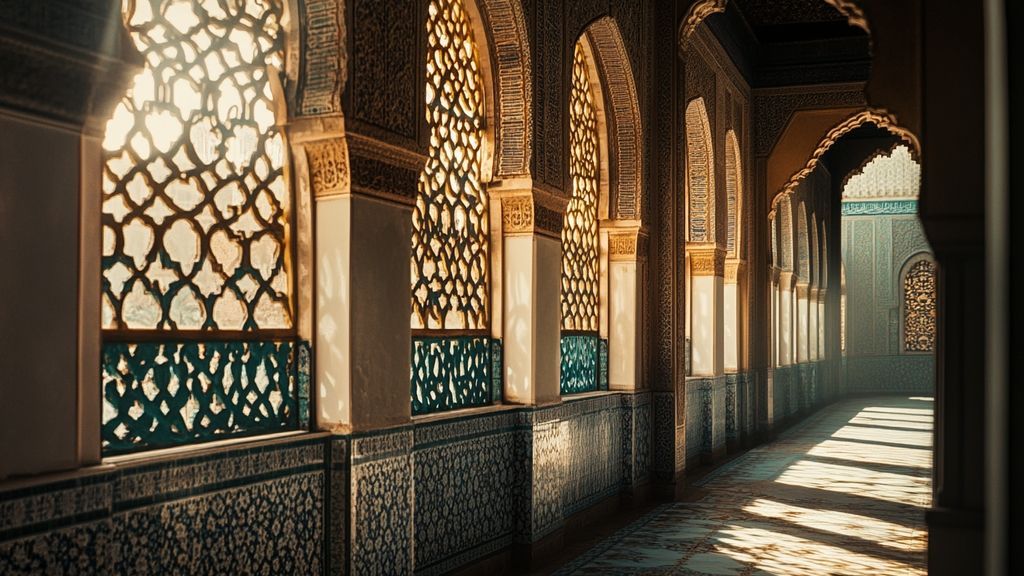
Mathematics has often been regarded as a means of communicating universal truths that transcend cultures and religions. In many religious traditions, numbers and geometric shapes are seen as sacred symbols, representing harmony and cosmic order. For instance, in Islam, geometry plays a crucial role in mosque architecture, where repetitive patterns illustrate divine perfection. This search for harmony is also found in artistic creations, where mathematical proportions are often applied.
Mathematics and the question of the existence of God
Throughout history, mathematics has been used as a tool to address the question of the existence of God. Philosophers like Gödel have even attempted to propose mathematical demonstrations of faith, notably through the famous ontological proof. Although these approaches have sparked debates, they show that mathematics can be used to illuminate profound philosophical questions, from the nature of the universe to our place as thinking beings.
Religion and belief in relation to mathematics
Opinions on the impact of mathematics in the domain of belief vary considerably. For some, mathematics represents a rational framework that may contradict faith, while others find that it deepens it. A new trend has developed around the idea that the human mind can find meaning and beauty in mathematical order, which could enhance a religious belief. Far from being opposed, faith and reason can coexist in this quest for understanding.
Mathematics and spirituality
Spirituality is another area where mathematics has a role to play. Contemplative practices, such as meditation, can be enriched by mathematical concepts. For example, some meditation traditions use mandalas, which incorporate mathematical principles to illustrate the structure of the universe and foster a state of inner harmony. Chaos theory can also offer reflections on the unpredictability of life, paving the way for a deeper understanding of our place in the cosmos.
Mathematics in the history of religions
Finally, it is important to examine how mathematics has shaped the history of religions. Antiquity saw civilizations like the Greeks and Arabs studying mathematical and geometric concepts, thus influencing the spiritual quest of their societies. Mathematics played a fundamental role in ancient astronomy, helping religions plan their rituals and organize time according to celestial movements. This shows that science and spirituality should not be seen as opposing forces but rather as interconnected elements that have evolved together throughout history.
FAQ – Mathematics and religions
- Can mathematics bring one closer to God?
- Yes, some people believe that mathematics can offer a deeper understanding of divine creation. They consider that mathematical principles and the order of the universe testify to a higher intelligence.
- What role does mathematics play in religious traditions?
- Mathematics is often present in religious traditions through symbols, rituals, and calculations related to sacred events, thus highlighting its importance in spirituality.
- Are mathematics considered a form of religion?
- While some see mathematics as a rigorous discipline, it is generally accepted that it cannot replace faith or religious beliefs. Mathematics and religion are distinct fields.
- Are there mathematical theorems related to religious concepts?
- Yes, some theories, such as the ontological proof of the existence of God, have been formulated in mathematical terms, seeking to establish links between mathematics and spirituality.
- How do religious cultures perceive mathematics?
- Interpretations of mathematics vary across cultures; some cultures, such as those in Islam, have placed great importance on mathematical analysis, promoting scientific and spiritual exploration.
- Can the importance of mathematics in understanding faith be assessed?
- Yes, numbers, models, and formulas can help form arguments and explore abstract concepts, providing new insights into questions of faith.