|
IN BRIEF
|
Pulsars are among the most fascinating discoveries of modern astronomy, marking over 50 years of exploration. These neutron stars are characterized by rapid rotation, emitting a remarkably precise beam of radio waves. This phenomenon is due to the intense magnetic field surrounding these celestial bodies, creating a complex radiation mechanism. Through their rhythmic oscillation, pulsars behave like beacons in the vastness of the universe, providing the scientific community with invaluable opportunities to study extreme physical properties and learn more about the cosmic processes that govern our cosmos.
Pulsars, these mysterious neutron stars, have captivated the imagination of astronomers for almost 50 years. They emit beams of radio waves with remarkable precision, oscillating at a frequency that can be as short as a fraction of a second. This article explores the nature of pulsars, their radiation emission process, and their fascinating role in the universe.
What is a pulsar?
A pulsar is a neutron star, the remnant of a supernova, which has incredible density. These compact objects are created when massive stars explode at the end of their life cycle, leaving behind a core that compacts under the force of gravity. When this neutron star spins, sometimes at astonishing velocities, it emits a beam of radio waves due to its powerful magnetic field, creating a fascinating phenomenon.
The emission mechanism
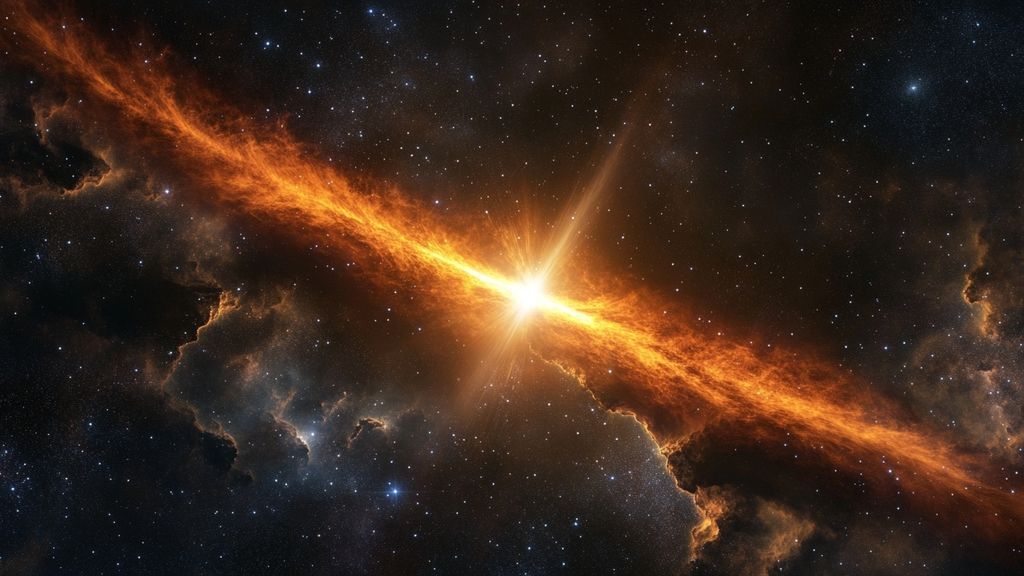
The radiation emitted by a pulsar is derived from the combination of rapid rotation and the intense magnetic field of the neutron star. As the pulsar rotates, its magnetic field tilts the radio emission beam, comparable to a lighthouse sweeping the sea. When this beam is directed towards Earth, we perceive it as a regular pulse, which allows us to determine key information about the object.
Pulsars in a binary system
Some pulsars are found in binary systems, where they are associated with another star. In such cases, the pulsar can receive matter from its companion, which can accelerate its rotation. This mass transfer is a complex process that affects the pulsar’s behavior, and pulsars in binary systems are often studied to understand the dynamics of these fascinating interactions.
Types of pulsars
There are several types of pulsars, each exhibiting unique characteristics. Radio pulsars, for example, emit detectable radio waves through radio telescopes. On the other hand, gamma pulsars emit much more energetic radiation. These different types result from variations in their rotation, their magnetic field, and the surrounding environment.
Astronomical applications of pulsars
Pulsars are not only fascinating study objects, but they also have major applications in astronomy. They serve as true cosmic clocks, enabling astronomers to measure distances, masses, and even study the effects of relativity. By analyzing the rhythm of pulsars, scientists can deduce valuable information about the structure and evolution of our universe.
The challenges of studying pulsars
Although pulsars are fascinating objects, their study presents challenges. The precision of signal measurement can be affected by radio interference and atmospheric effects. Additionally, understanding the internal mechanisms of these neutron stars requires advanced tools and significant expertise. Astronomers must therefore rely on cutting-edge technologies to continue unraveling the mysteries of pulsars.
The future of pulsar research
In the future, pulsar research is expected to intensify, particularly thanks to the development of new telescopes and dedicated space missions. These advancements will allow for a deeper exploration of the workings of pulsars and their impact on current physics theories. The study of pulsars remains an exciting and promising field, both for professional astronomers and enthusiasts.
Comparative table on pulsars and their functioning
| Characteristic | Description |
| Nature | Very dense and compact neutron star. |
| Rotation | Rotate rapidly on themselves, often in less than one second. |
| Emission | Emit beams of radio waves concentrated along their magnetic axis. |
| Pulsation | Emit regular pulses, similar to a bright lighthouse. |
| Binary system | Can be found with a companion star, thus exchanging matter. |
| Radiation | Emit very energetic electromagnetic radiation. |
| Types of pulsars | Include binary pulsars and millisecond pulsars. |
| Impact on research | Used to study gravity and the structure of the universe. |
Pulsars are fascinating neutron stars that lie at the heart of the universe, captivating astronomers with their complexity and regularity. Emitting beams of radio waves, they resemble cosmic beacons illuminating the skies. This article explores their nature, their operating mechanics, and recent discoveries that have enriched our understanding of pulsars over the years.
What is a pulsar?
A pulsar is an extremely dense neutron star that spins at incredible speeds, with a typical period of about a second, although some pulsars have much shorter periods. When these massive stars reach the end of their life cycle, they explode into supernovae, leaving behind compact remnants that transform into pulsars.
The emission mechanism of pulsars
The operation of a pulsar relies on a captivating mechanism. When a neutron star spins, its intense magnetic field engages, leading to the creation of an electric field that accelerates particles. This process generates beams of electromagnetic radiation that pulse through space like a lighthouse. These beams are often cone-shaped along the star’s tilted magnetic axis, hence the pulsation phenomenon when the beam sweeps across our line of sight.
Binary pulsars
Among pulsars, some are found in binary systems, sharing their orbit with a companion star. In these systems, a pulsar can “recycle” by accessing matter from its neighboring star, which can affect its rotation and brightness. This interaction process opens a whole new dimension of exploration for astronomers seeking to understand the properties of pulsars.
The discovery and scientific impact
Since their discovery over 50 years ago, pulsars have revolutionized our understanding of the cosmos. As study objects, they have allowed testing theories of relativity and particle physics while providing valuable insights into phenomena such as gravitational waves. With NASA’s NICER mission and other projects, astronomers continue to make exciting advances in the analysis of these celestial objects.
- Definition: A pulsar is a rapidly rotating neutron star.
- Main property: Emits beams of radio waves.
- Origin: Forms from massive stars at the end of their life.
- Rotation: Typical rotation period of less than one second.
- Energy emitted: Very energetic radiation in electromagnetism.
- Binary pulsar: Pulsar interacting with a companion star.
- Operation: Produces an electric field through its magnetic field.
- Stability: Emits regular pulses, creating a precise rhythm.
- Recycling effect: Can increase its rotation by absorbing matter.
- Exploration: Observed through space missions like those of NASA.
Introduction to pulsars
Pulsars are fascinating celestial objects that reveal a wealth of information about the universe. They are very dense neutron stars, resulting from the collapse of massive stars. Thanks to their rapid rotation and powerful magnetic field, pulsars emit striking beams of radio waves that can be detected from Earth. In this article, we will explore how pulsars operate, how they are born, and the implications of their regular signals for astronomical research.
What is a pulsar?
A pulsar is a neutron star that spins rapidly, sometimes continuously at intervals of around a second or less. This rapid rotation is accompanied by an extremely strong magnetic field, leading to the emission of beams of electromagnetic radiation. These beams are oriented along the star’s magnetic axis, which is generally tilted relative to its rotation axis. When these beams pass by Earth, we perceive them as regular pulses, like a lighthouse in the night.
The formation of pulsars
Pulsars are born from the explosion of a massive star during a supernova. When the star exhausts its nuclear fuel, its core collapses, forming a neutron star. In this phase, the star can retain a mass of up to three times that of the Sun, but in an extremely reduced volume, granting it incredible density. Pulsars can be isolated or found in binary systems, that is, orbiting with another star. In these cases, a pulsar can even “recycle” its rotation through the matter transferred by its companion, thus enhancing its rotation speed.
The emission mechanism of pulsars
The process that leads to the emission of radiation in pulsars relies on the interaction between the magnetic field and the rotation of the star. Indeed, the rotation of the neutron star creates an electric field at its nearby environment, allowing certain particles to gain energy. These high-energy particles are then accelerated along the magnetic field lines, emitting radio and other forms of radiation. This behavior is similar to that of a lighthouse illuminating its surroundings as it spins.
The diversity of pulsars
There are different types of pulsars, each with its specific characteristics. Binary pulsars are those associated with another star, and these can exhibit irregular emission periods due to matter transfers. Conversely, some pulsars, called millisecond pulsars, rotate at incredibly high speeds, reaching up to several hundred times per second. This rapidity grants them unique properties that are of great interest to astrophysics researchers.
Applications and research around pulsars
Pulsars play a crucial role in astrophysics. Due to their regularity, these objects are used as cosmic clocks, allowing astronomers to measure time accurately and test theories of relativity. Furthermore, they represent potential tools for studying extreme stellar phenomena and even for considering future research on the limits of physics. Recent discoveries, particularly those related to the Fermi mission, continue to expand our understanding of pulsars and the universe as a whole.
FAQ about pulsars and their functioning
What is a pulsar? A pulsar is a neutron star that rotates rapidly, emitting beams of radio waves at regular intervals.
How is a pulsar formed? Pulsars are born from the collapse of massive stars at the end of their life cycle in a supernova explosion.
What is the emission mechanism of a pulsar? The pulsar emits radiation due to its intense magnetic field and rotation, creating a radiant beam that sweeps through space.
Why do pulsars emit radio? Pulsars emit these waves due to the movement of charged particles in their electric field, which is generated by their rotation.
What is a binary pulsar? A binary pulsar is a system composed of a pulsar and a companion star orbiting around each other, allowing the pulsar to “recycle.”
What is the rotation speed of pulsars? The rotation period of pulsars varies, with some spinning in less than a second, making them the fastest known objects in our universe.
What types of radiation do pulsars emit? Pulsars primarily emit radio radiation, but some may also emit high-energy gamma radiation.
How do scientists study pulsars? Scientists use radio telescopes to detect and analyze the radio signals emitted by pulsars in order to learn more about their functioning and environment.