The role of cosmic rays in the universe

Le rôle des rayons cosmiques dans l'univers

IN BRIEF Cosmic rays: high-energy subatomic particles coming from space. Messengers of violent events in the universe. Composed mainly of protons and atomic nuclei. Create large showers of secondary particles upon their manifestation. Constantly bombard the Earth and impact our atmosphere. Represent one of the greatest dangers for astronauts in space exploration. Play a crucial … Read more

The philosophical implications of the sciences of the universe

Les implications philosophiques des sciences de l'univers

IN BRIEF Reexamination of fundamental notions: substance, time, causality. Study of the concepts of evolution regarding the universe and societies. Analysis of the foundations and methods of philosophy of science. Questioning the value and consequences of scientific research. Exploration of the philosophical and spiritual implications of modern physics. Cosmology as a physical system raising philosophical … Read more

The origin and evolution of galaxies

L'origine et l'évolution des galaxies

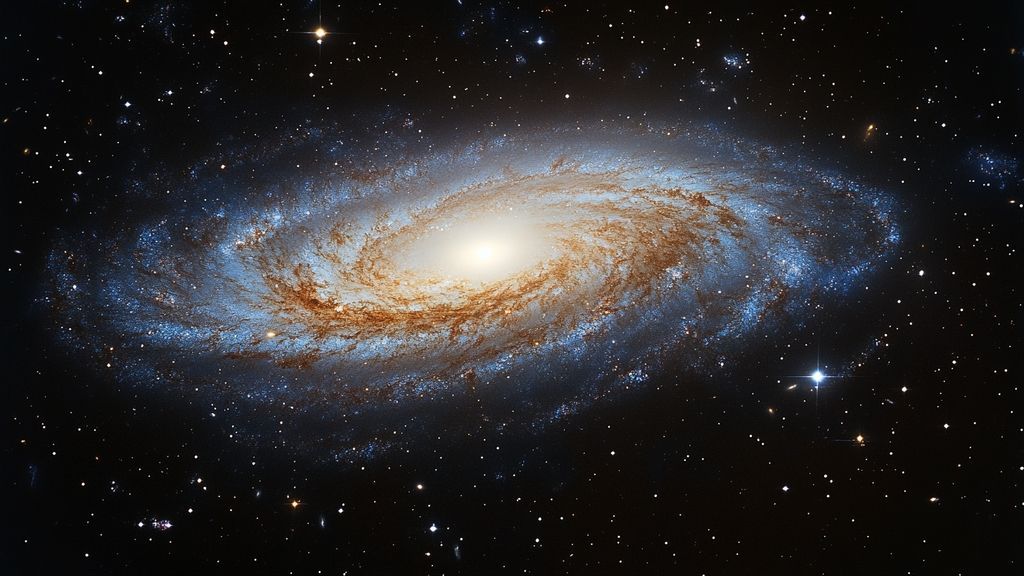
IN BRIEF Origin of galaxies: results from small fluctuations in density in the primitive universe. Formation: process by merging dwarf galaxies and gravitational collapse. Types of galaxies: include spiral galaxies, with a disk of gas, dust, and stars. Evolution: linked to each galaxy’s ability to create stars. Environment: evolution depends on local physical and chemical … Read more

Cosmic filaments: structure of the universe

Les filaments cosmiques : structure de l’univers

IN BRIEF Cosmic filaments: thread-like structures made up of galaxies and galaxy clusters. Comprise the cosmic web, a complex network of empty spaces surrounded by walls of matter. Filaments can extend for hundreds of millions of light-years. First observed, they reveal the largest cosmic structures in rotation. Organize the matter of the Universe on a … Read more

Interactions between galaxies: collisions and mergers

Les interactions entre galaxies : collisions et fusions

IN SHORT The interaction between galaxies results from the gravitational field of other galaxies. Galactic collisions generate instabilities promoting the formation of spiral arms. Following a merger, stars ignite, and supermassive black holes activate. These events cause superwinds and cosmic chaos, but not total disaster. Many galaxies have already experienced interactions in their history. The … Read more

Numerical simulations in cosmology: creating the universe in the laboratory

Les simulations numériques en cosmologie : créer l'univers en laboratoire

IN BRIEF Numerical simulations to study the Universe. Used by physicists to simulate the inflation of the Universe. Objective: to create a model of the entire observable Universe. Analysis of stars, galaxies, black holes, etc. Essential tool for understanding cosmological processes. Simulations aiding in retracing the history of the Universe. Illustration of the ongoing expansion … Read more

The influence of quasars on the evolution of galaxies

L'influence des quasars sur l’évolution des galaxies

IN BRIEF Quasars: Immense black holes at the heart of galaxies. Energy emission: They produce significant amounts of energy by devouring matter. Cosmic evolution: Help in understanding the evolution of the Universe. Interaction with galaxies: Influence the formation and evolution of galaxies. Quasar winds: Produce jets of radiation altering the galactic environment. Energy role: Among … Read more

The fluctuations of the cosmic microwave background

Les fluctuations du fond diffus cosmologique

IN BRIEF Cosmic Microwave Background (CMB): fossil radiation of the universe Fluctuations: temperature differences, indicating anisotropies Blue regions: cooler, indicating areas of low energy Red regions: warmer, signaling areas of high energy Inflation: early period of the universe explaining certain fluctuations Measurements by satellites WMAP and Planck CMB reveals characteristic B modes Temperature dipole: origin … Read more

The large ground-based telescopes for cosmology

Les grands télescopes terrestres pour la cosmologie

IN SHORT Gran Telescopio de Canarias: Primary mirror with a diameter of 10.4 meters. European Extremely Large Telescope (ELT): Expected to open in 2027 with a mirror of 39 meters. Very Large Telescope (VLT): Flagship equipment of European astronomy. Southern African Large Telescope (SALT): Mirror of 11.1 meters. Schmidt Telescopes: Used for photographic astrometry. Large … Read more

The formation of the first atoms after the Big Bang

La formation des premiers atomes après le Big Bang

IN BRIEF Primordial nucleosynthesis: Formation of the first atoms after the Big Bang. Timing: Approximately 380,000 years after the Big Bang. Elements formed: Mainly hydrogen and helium. First molecule: The ion HeH+, possibly the first molecule. Conditions: Initial temperatures around 10^9 K. Electrons and atoms: Electrons combine with nuclei to form atoms. In the vastness … Read more