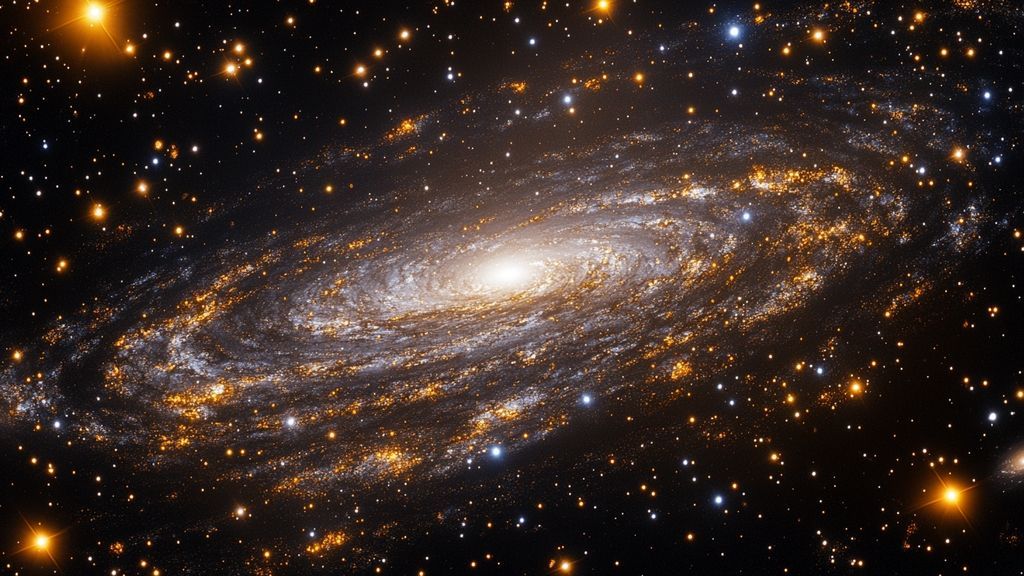
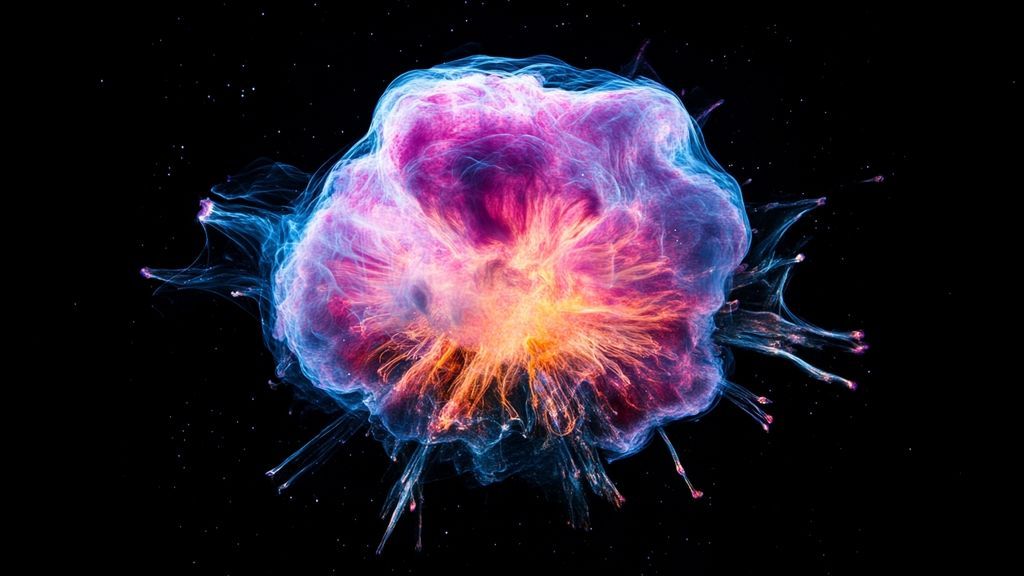
The big bang: the birth of the universe according to physics

Le big bang : la naissance de l'univers selon la physique

IN BRIEF Big Bang: explosive event marking the birth of the Universe Occurred about 13.7 billion years ago Emergence of a dense and hot Universe The Big Bang theory supported by contemporary observations Universe continuously expanding since its creation Questions about the origin: what happened before? No defined time before the Big Bang Exploration of … Read more

Museums and exhibitions dedicated to physics

Les musées et expositions dédiés à la physique

IN BRIEF Exhibition “Teaching Physics, an Art!” at the Bernard d’Agesci Museum. Topics covered: optics, weight and measures, electricity. Initiatives related to the 2024 Paris Olympic and Paralympic Games at the Curie Museum. Curie Museum: historical site, modern equipment near the Panthéon. Immersive Science Museum in Lyon, offering unique experiences. New exhibition in Rouen on … Read more

Electromagnetism: electric and magnetic field

L'électromagnétisme : champ électrique et magnétique

IN BRIEF Electromagnetism: study of interactions between charged particles. Electromagnetic field: combination of electric and magnetic fields. An electric field is associated with a voltage. A magnetic field arises from moving electric charges. Both fields are inseparable and interact with each other. An electric current generates both an electric field and a magnetic field. The … Read more

The role of symmetry in physics

Le rôle de la symétrie en physique

IN BRIEF Symmetry: Fundamental concept in physics, reflecting the invariance of a system under transformations. Transformations: Symmetries can be associated with changes such as rotations or inversions. Symmetry groups: Mathematical structure that formalizes the relationships between symmetries and physical laws. Conservation: Each symmetry leads to the conservation of a physical quantity, according to Noether’s theorem. … Read more

Cosmology and the Origin of the Universe

La cosmologie et l'origine de l'univers

IN BRIEF Big Bang: cosmic event marking the origin of the Universe according to the current cosmological model. Origins of the Universe: study of the conditions preceding and following the Big Bang. Formation Eras: the Universe evolved through the radiation era, followed by the matter era. String Theory: suggests that the Big Bang could be … Read more

Gravitational waves and their implications

Les ondes gravitationnelles et leurs implications

IN BRIEF Gravitational waves: oscillations of the curvature of space-time. Produced by cosmic events such as supernovae and black holes. Validation of general relativity by Albert Einstein in 1916. Detection possible thanks to installations like LIGO. Important consequences for modern astrophysics and the study of universes. Access to invisible phenomena that enrich our understanding of … Read more

Recent discoveries in fundamental physics

Les découvertes récentes en physique fondamentale

IN BRIEF Discovery of a new force of nature. Identification of HD1, the oldest galaxy. Future of particle physics post-Higgs boson. Advances in quantum physics opening new research avenues. Dynamics of volcanoes illuminated by recent studies. Potential of future discoveries in fundamental physics. Evaluation of the large hadron collider (LHC). Impact of discoveries on the … Read more

The fundamental forces: gravity, electromagnetism, and more

Les forces fondamentales : gravité, électromagnétisme et plus

IN BRIEF Four fundamental forces: gravitational force, electromagnetic force, strong nuclear force, weak nuclear force. Gravity: attraction of all masses, the weakest force. Electromagnetism: framework force of matter and responsible for interactions between electric charges. Strong nuclear force: holds protons and neutrons bound in the atomic nucleus. Weak nuclear force: involved in certain forms of … Read more

Newton’s Laws: Explanation and Practical Applications

Les lois de Newton : explication et applications pratiques

IN BRIEF First law: Principle of inertia, an object at rest remains at rest, and an object in motion retains its velocity. Second law: Relationship between force, mass, and acceleration (F = ma). Third law: For every action, there is an equal and opposite reaction. Newton’s laws are the foundations of classical mechanics. Applications: used … Read more

The role of mathematics in physics: a universal language

Le rôle des mathématiques en physique : un langage universel

IN BRIEF Mathematics as a universal language Relation with physics, biology, computer science Essential role to understand the world Mathematical logic for decision making Application in research and conferences Universality of mathematics in sciences Importance of theorems and fractals Theory of chaos and its implications In the field of physics, mathematics plays a fundamental role, … Read more