|
IN BRIEF
|
The Moon, Earth’s only natural satellite, plays a fascinating role in the Earth-Moon system. Its phases cycle, spanning about 29 days, continuously transforms its appearance from new Moon to full Moon and vice versa. These variations are not merely celestial spectacles; they also have measurable impacts on our planet. The Moon’s gravitational effects notably influence tides and may even have repercussions on climate and the biological behaviors of living beings. Understanding lunar phases means diving into a world where astronomy and ecology intertwine in fascinating ways.
The phases of the Moon represent a cycle of varied illuminations that occur over the days. This phenomenon, visible from Earth, not only has a visual impact but also significant repercussions on our planet. This article explores the different lunar phases, their cycle, and the effects these variations have on Earth, particularly on tides, climate, and even human behaviors.
The different phases of the Moon
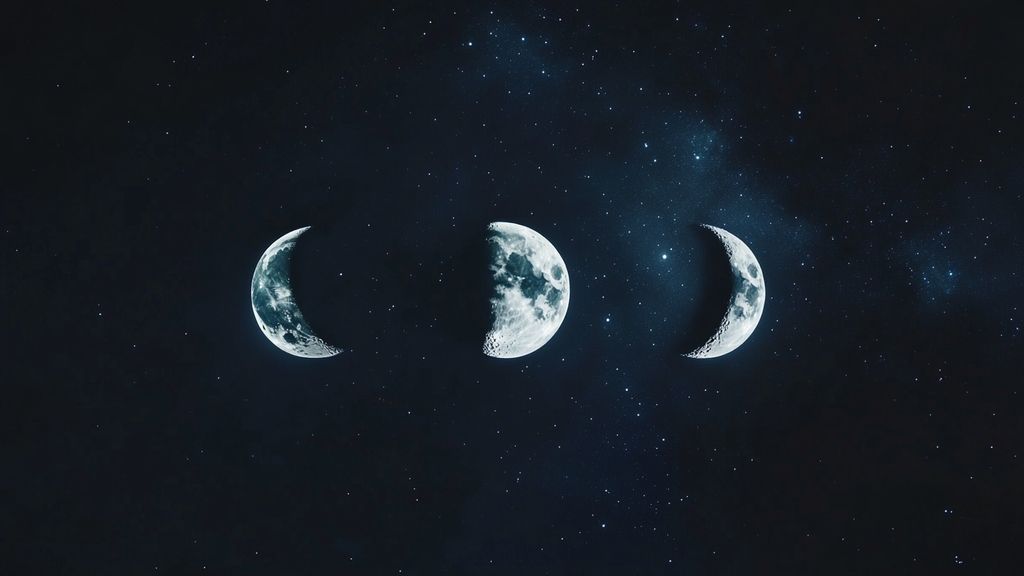
The Moon goes through several distinct phases during a lunar cycle that lasts approximately 29.5 days. This cycle begins with the new Moon, when the visible side of the Moon is completely in shadow. As the Moon orbits around the Earth, it enters the first quarter phase, where half of its disk is lit. Then, during the full Moon, the Moon is completely illuminated, providing a spectacular view.
After that, the Moon returns to its new Moon state by passing through the last quarter phase, where another half is visible. Throughout this cycle, the Moon presents variations between the waxing Moon and the waning Moon, influencing our perception of its appearance.
The impact of lunar phases on tides
The Moon exerts a gravitational influence on the Earth, which is primarily observable through tides. Lunar phases, particularly during the full Moon and new Moon, create stronger tides due to the alignment of the Sun and the Moon. These tides are called spring tides and reach their maximum during these particular phases.
Conversely, during the first and last quarter phases, the tides are less pronounced. These are known as neap tides, resulting from an angle formed between the Earth, the Moon, and the Sun. This underscores the importance of the Moon’s position in its cycle on the water levels of oceans and seas.
The effects of the Moon on climate
In addition to regulating tides, the Moon also plays a role in determining certain aspects of Earth’s climate. While this impact is subtle, scientists are studying how lunar phases can influence certain weather phenomena. For instance, variations in light and darkness associated with the different phases of the Moon can alter heat and humidity in the atmosphere.
These factors can have repercussions on climatic events such as storms and rains in certain regions of the globe, thereby influencing local biodiversity and ecosystems.
The repercussions on human behavior
Many cultures throughout history have attributed psychological effects to the full Moon and its phases. Although scientific evidence is still debated, some studies suggest that the full Moon may be linked to changes in human behavior, such as increases in hospital admissions or more agitated behaviors.
These popular beliefs may be attributed to the increase in nighttime light during the full Moon, which could affect sleep cycles and human psychology. Further research continues to explore this intriguing relationship between the Moon and human behaviors.
Lunar Phases and Their Impact on Earth
| Lunar Phase | Impact on Earth |
| New Moon | Less night light, promotes stargazing. |
| First Quarter | Increased tides, influences coastal ecosystems. |
| Full Moon | Increased brightness, impacts animal behavior and tides. |
| Last Quarter | More moderate tidal fluctuations, impacts natural cycles. |
| Waxing Gibbous Moon | Increasing brightness, influences nocturnal biodiversity. |
| Waning Gibbous Moon | Decreasing brightness, soothing effects on certain species. |
The Moon, our natural satellite, occupies a prominent place in the night sky. Through its different phases, it influences not only the nocturnal landscape but also several aspects of our planet. This article invites you to explore lunar phases and the effects they have on Earth.
Understanding Lunar Phases
The cycle of lunar phases lasts approximately 29 days and 12 hours. It begins with the new Moon, when the Moon is positioned between the Earth and the Sun, making it completely invisible. As the Moon moves through its orbit, part of its surface becomes illuminated, gradually leading to the first quarter phase, where a half-lit disk is visible.
From Full Moon to Waning Gibbous
The full Moon phase is fascinating, as this is when the visible face of the Moon is fully illuminated by sunlight. From this stage, the Moon enters the waning gibbous phase, beautifully illustrating the natural cycle that surrounds us.
The Impact of Lunar Phases on Earth
The effects of lunar phases manifest in various ways on our planet. One of the most notable impacts is related to tides, which are primarily caused by the Moon’s gravitational attraction. Sea level variations can be observed during lunar phases, with higher tides occurring during new and full Moons.
Influence on Climate and Daily Life
Even more astonishing, the Moon also has a subtle influence on the climate and could affect certain weather conditions. Many farmers take into account the lunar phases to plan their activities, believing that some periods are more favorable for sowing or harvesting.
Astronomical and Educational Observations
The various phases of the Moon represent an invaluable learning opportunity for astronomy enthusiasts and curious young minds. Observing the lunar cycle can ignite an interest in science and enhance our understanding of the fascinating mechanics of our solar system.
A Source of Inspiration
The beauty of lunar phases has inspired artists, poets, and writers for centuries. They continue to evoke fascination and nourish our collective imagination, reminding each of us of the Moon’s unique place in our sky.
- New Moon: The Moon is completely in shadow, which affects tides and marks the beginning of a new cycle.
- First Quarter: The right half of the Moon is illuminated, leading to rising tides, conducive to water activities.
- Full Moon: The Moon is fully illuminated, which can influence nighttime brightness and animal behavior.
- Last Quarter: The left half is visible, this phase is often associated with a slowdown in plant growth.
- Influence on Tides: The position of the Moon in relation to the Earth significantly impacts tides due to its gravitational pull.
- Climate: Lunar phases can have a subtle effect on weather conditions, influencing humidity and air currents.
- Lunar Cycle: Lasts about 29.5 days, affecting the biological rhythms of many organisms on Earth.
- Culture and Traditions: The phases of the Moon influence many cultural events and rituals in various civilizations.
Introduction to Lunar Phases
The lunar phases are a fascinating phenomenon that plays a crucial role in our understanding of celestial dynamics. The Moon, as Earth’s natural satellite, undergoes a cycle of phases lasting about 29 days, influencing various aspects of our planet, from ecology to human behaviors. This text explores the different lunar phases, their impact on Earth, and the wonders they generate.
The Lunar Phases
The New Moon
The new Moon marks the beginning of the lunar cycle. At this stage, the Moon orbits between the Earth and the Sun, rendering its unlit surface almost invisible from Earth. This phenomenon creates a feeling of renewal, often associated with purification rituals and new intentions, both spiritually and environmentally.
The First Quarter
During the first quarter, about half of the Moon’s surface is illuminated. This moment is often ideal for observing lunar craters and mountains due to the angle of illumination. On Earth, this phase is associated with increased high tides, demonstrating the existence of significant gravitational influence.
The Full Moon
The full Moon is undoubtedly the most captivating phase. At this moment, the Moon is fully illuminated by the Sun, offering a spectacular glimpse of its beauty. Tides reach their maximum during this phase, increasing their impact on marine life and coastal ecosystems. Additionally, fluctuating human behaviors are often observed during the full Moon cycle, generating particular interest among psychologists and anthropologists.
The Last Quarter
At the last quarter, the opposite half of the Moon is illuminated, indicating that the cycle is nearing its end. This often symbolizes a moment of reflection and closure, perfect for assessing the progress made during the previous cycle. Tides begin to decrease, which can influence fishing activities and ecological processes in certain regions.
The Impact of Lunar Phases on Earth
The lunar phases, in addition to their beauty, have a significant impact on our planet. For instance, variations in light and shadow affect the biological cycles of many organisms, influencing reproduction, migration, and other behaviors essential for survival.
The Tides
Due to the Moon’s gravitational attraction, tides experience variations throughout the lunar phases. High and low tides occur with greater intensity during the full and new Moons, affecting coastal ecosystems and marine life. These maritime variations also create favorable conditions for certain fish species that take advantage of the tides for reproduction.
Influence on Beliefs and Rituals
The phases of the Moon have also marked human culture throughout the ages. Many ancient civilizations interpreted lunar phases as divine signs. Currently, some wellness and spiritual practices rely on the lunar cycle, encouraging people to align their activities with the different phases.
Moon Observation
Observing the lunar phases can be a rewarding experience. With a simple pair of binoculars or a telescope, one can explore the lunar landscapes, such as the seas and craters that are more easily identifiable during the intermediate phases. Learning about and discovering these phases can ignite a passion for astronomy in both young and adult learners, fostering a deep connection with our universe.