|
IN BRIEF
|
Modern astronomy relies on a deep understanding of the physical laws that govern our Universe. This discipline, dedicated to the observation and interpretation of celestial objects, is closely tied to fundamental discoveries in physics. Thanks to the groundbreaking work of pioneers like Galileo and Newton, universal gravitation was formulated, thus unifying numerous observations of the sky. Today, physics is essential for explaining phenomena such as spectroscopy, the expansion of the Universe, and the nature of galaxies, providing crucial insight into our place and understanding of the cosmos. Advances in this field continue to transform our approach to astronomy, integrating knowledge from atomic physics, materials, and the forces that shape the Universe.
Physics plays a fundamental role in modern astronomy, allowing scientists to understand the properties, origin, and evolution of celestial objects. By integrating physical principles into the observation of celestial bodies, astronomers are able to decipher the mysteries of the universe. This article explores this intricate relationship between physics and astronomy, highlighting how discoveries in physics have shaped our understanding of galaxies, stars, and planetary systems.
Universal Gravitation: A Fundamental Pillar
One of the most remarkable aspects of the relationship between physics and astronomy is universal gravitation, formulated by Isaac Newton. This principle explains how celestial bodies interact, both within our solar system and beyond. Newton unified astronomy and physics, demonstrating that the same laws apply both on Earth and throughout the universe. Thanks to this understanding, astronomers can predict the movements of planets and comets, tracing their paths in space.
Advances in Modern Physics
Over the centuries, advances in modern physics have deepened our knowledge of the universe. Einstein’s theories of relativity fundamentally changed our perception of space and time, particularly by explaining how the curvature of spacetime affects the movements of celestial bodies. These concepts are essential for understanding phenomena such as the light from stars that reaches us, or how masses influence the trajectories of spatial objects.
Physics in Astronomical Observation
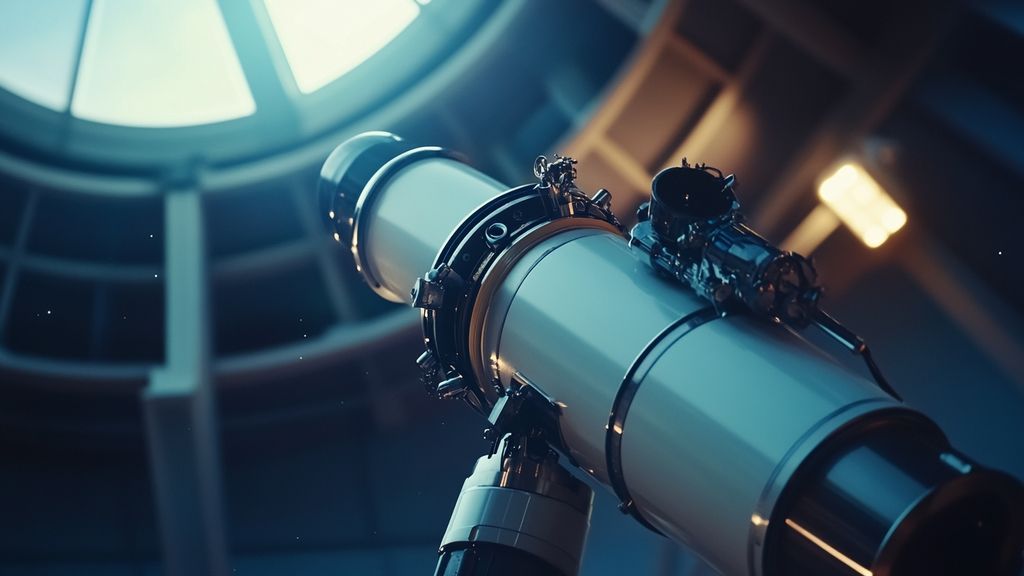
The use of physical tools to observe the universe is another example of the interaction between these two disciplines. Telescopes, for instance, are instruments designed based on physical principles such as optics and light. The discoveries made possible by these instruments, such as those of exoplanets through the transit method, would not be feasible without the strength of the foundation in physics. By scrutinizing the movements of light and particles, astronomers can extract crucial information about the composition and dynamics of celestial bodies.
Understanding the Nature of Celestial Objects
Physics also plays a key role in our understanding of the nature of celestial objects. By using tools such as spectroscopy, scientists analyze the light coming from stars and galaxies to determine their composition, temperature, and speed. These analyses reveal valuable information about the range of elements in the universe, the formation of galaxies, and the dynamics of stellar systems. This approach helps establish links between atomic physics and astrophysics, thereby enriching our overall understanding.
Contemporary Challenges and the Future of Astronomy
As we enter an unprecedented era of cosmic exploration, contemporary challenges in physics in astronomy are multiplying. Concepts such as dark matter and dark energy question the very foundations of our physical understanding. The image of a dynamically expanding universe poses new questions that require ever more sophisticated tools and theories. Addressing these issues, the collaboration between astronomers and physicists paves the way for a better understanding of our universe.
An Interdisciplinary Future
The connection between physics and astronomy is essential for advancing scientific research. Futuristic projects, such as building large detectors to observe gravitational waves, demonstrate how these two disciplines are closely linked. These innovations aim to unravel the mysteries of the universe and make science accessible to the general public. By making science popularization more effective, these initiatives contribute to popularizing physics and astronomy on a global scale. Thus, the prosperity of these fields will be determined by their capacity to innovate and collaborate.
Comparison of the Roles of Physics in Modern Astronomy
| Aspect | Role of Physics |
| Modeling Celestial Objects | Use of physical laws to predict the behavior of stars and planets. |
| Force Interaction | Application of the principles of gravitation to understand orbits and movements. |
| Spectroscopic Analysis | Interpretation of light spectra to identify the composition of celestial bodies. |
| Study of Cosmic Phenomena | Development of physical models to explain events such as supernovae. |
| Expansion of the Universe | Use of cosmology concepts to explore the origin and evolution of the Universe. |
| Search for Life | Application of biological and physical principles to identify habitable zones on other planets. |
| Detection Technology | Physical approach behind observation tools like telescopes and satellites. |
The Role of Physics in Modern Astronomy
Physics plays a crucial role in our understanding of the universe and its mysteries. Through modern astronomy, it allows us to observe and analyze celestial phenomena by providing essential theoretical and practical tools. This article will explore how physics shapes our vision of the cosmos.
A Symbiosis between Physics and Astronomy
Astronomy is, both, a science of observation and a science that relies on physical principles. Discoveries such as universal gravitation, formulated by Newton, unify these two disciplines, allowing us to understand how celestial objects interact with each other. Thus, the study of planets, stars, and galaxies is closely tied to the laws of physics.
Physical Tools in Astronomical Observation
Over the centuries, techniques like spectroscopy have revolutionized our ability to analyze the light emitted by celestial bodies. For example, the chemical composition, temperature, and velocity of stars can be revealed using these methods. Similarly, instruments such as telescopes and radio telescopes exploit fundamental physical principles to extend our perception of the universe beyond what our naked eye can detect.
The Impact of Physical Discoveries on Our Understanding of the Universe
In the 19th and 20th centuries, modern physics opened doors to new horizons. Theories such as special relativity and quantum mechanics have been essential in explaining phenomena such as the expansion of the universe. These concepts provide theoretical frameworks for interpreting the evolution of galaxies and the very nature of dark matter.
Science Popularization: Making Physics Accessible
One of the major challenges of our time is to make science accessible to all. The popularization of physics, through lectures, books, or articles, helps demystify the complex concepts underlying astronomy. This allows the general public to understand the importance of this science in our daily lives and in our understanding of the universe.
The Future of Astronomy: Towards New Discoveries
With the advancement of technologies and analysis methods, the future of astronomy looks promising. Space missions, along with developments in telecommunications, open new possibilities for exploring the universe. Thus, physics will continue to be at the heart of modern astronomy, guiding us towards yet unexplored discoveries.
- Understanding the Universe: Physics allows us to decode the laws governing the Universe.
- Particle Observation: Analyzing elementary particles to understand dark matter.
- Gravitational Equations: Using Newton’s and Einstein’s laws to model celestial motions.
- Observation Technologies: Developing sophisticated instruments based on physical principles.
- Exoplanet Study: Applying physical techniques to detect planets outside our solar system.
- Cosmology: Exploring the origin and evolution of the Universe through theoretical physics.
- Star Evolution: Modeling nuclear fusion processes within stars.
- Spectroscopy: Analyzing light spectra to determine the composition of celestial objects.
- Big Bang Theory: Studying initial conditions through fundamental physical principles.
- Understanding Black Holes: Applying physical laws to elucidate the nature of black holes.
Physics plays a fundamental role in the field of modern astronomy, allowing us to explain and predict the behavior of celestial objects. This encompasses both understanding the laws that govern the Universe and the application of physical concepts to astronomical observations. This article highlights the essential interaction between these two disciplines and the importance of physics in advancing our knowledge of the Universe.
Unification of Knowledge: The Legacy of Newton
The development of modern astronomy would not be possible without the genius of Newton. His discoveries regarding universal gravitation have unified the different approaches of astronomy and physics. By establishing that the same physical laws governing the motion of bodies on Earth also apply to celestial objects, Newton paved the way for a more coherent and unified understanding of the Universe.
Applications of Gravitation
Gravitation is not limited to explaining the path of planets. It is used to predict astronomical events such as eclipses, tides, and even gravitational disturbances caused by massive bodies like black holes. These applications demonstrate how physics enables a deep understanding of natural phenomena.
Modern Physics in Astronomy: Spectacular Advances
With the advent of modern physics, particularly in the 20th century, advanced technologies have been developed to explore the Universe. Discoveries such as spectroscopy and the study of galaxies have allowed us to learn more about the chemical composition, structure, and evolution of celestial objects.
The Expansion of the Universe
One of the most notable discoveries in the field of modern astronomy is that of the expansion of the Universe. Through studies of the redshift of galaxies, physicists have been able to demonstrate that the Universe is constantly expanding. This discovery has not only reshaped our cosmological understanding but has also raised fascinating questions about the origin and fate of the Universe, questions that only the principles of physics can address.
The Physics of Particles: Towards a Deeper Understanding
Research in particle physics has also provided valuable insights into the nature of the Universe. Discoveries regarding elementary particles such as the Higgs boson have direct implications for our understanding of the fundamental forces acting in the Universe. This knowledge is crucial for modeling cosmic events such as star formation and galaxies.
Consequences for Astrophysics
Discoveries in particle physics have a profound impact on astrophysics by providing a theoretical framework for interpreting observations of cosmic phenomena. This includes, for example, the understanding of massive objects such as neutron stars and black holes, where relativistic and quantum effects must be taken into account.
Modern physics is inseparable from astronomy. Every scientific discovery is the result of an interaction between these two fields, each nourishing the other to deepen our understanding of the Universe. The contributions of physics are vital for deciphering the vast cosmos that surrounds us and for appreciating the laws that govern our very existence.
FAQ on the Role of Physics in Modern Astronomy
What is the importance of physics in modern astronomy? Physics plays a fundamental role in modern astronomy, as it explains the physical and chemical properties of celestial objects, as well as their origin and evolution.
How has physics contributed to our understanding of the Universe? Through established physical laws, astronomers can analyze phenomena such as gravitation, the light from stars, and radiation, allowing for modeling and better understanding of the structures and dynamics of the Universe.
Who played a key role in the unification of astronomy and physics? The genius of Newton was crucial in unifying the different approaches to astronomy and physics, particularly through the discovery of universal gravitation.
What physical tools are used in astronomy? Astronomers use various tools derived from physics, such as spectroscopy, which allows for the analysis of the light from stars to determine their chemical composition and movement.
How does atomic physics influence astronomy? Atomic physics helps us understand the formation of elements in the Universe and their distribution among various celestial bodies.
What key discoveries have marked the history of modern astronomy? Discoveries regarding the nature of galaxies, the expansion of the Universe, and advancements in spectroscopy are some of the major contributions that have shaped our understanding of the Universe.
Why is Galileo considered a pioneer of modern physics in astronomy? Galileo, with his observations, laid the groundwork for mechanical sciences and promoted the use of experimental methods, establishing principles that still hold in modern astronomy.
What are the current challenges faced by modern astronomy? Modern astronomy faces challenges such as the exploration of dark matter, dark energy, and the search for extraterrestrial habitats.
How is scientific popularization related to astronomy? Scientific popularization allows for making discoveries in astronomy accessible to the general public, fostering interest and understanding of science in a broader context.