|
IN BRIEF
|
Light is a fascinating phenomenon that plays an essential role in our daily lives. In physics, it is defined as a visible electromagnetic wave, capable of propagating through a vacuum without requiring a material medium. Understanding light reveals to us not only the fundamental principles of physics, but also paves the way for numerous technological and scientific applications. The properties of light, such as its speed, its ability to propagate as photons, and its behavior as both wave and particle, are key elements that deserve exploration. By analyzing these characteristics, we can better understand how light interacts with matter, thus creating the visual phenomena that surround us.
Light is a fascinating phenomenon that is a central element of our understanding of the world. As an electromagnetic wave, it plays an essential role in visual perception, communication, and several technological applications. This article explores the different properties of light, its nature, and its impact on our daily lives.
The Nature of Light
Light can be defined as a form of visible electromagnetic energy to the human eye. It propagates in the form of particles called photons and behaves both as a wave and as a particle, which is referred to by the wave theory and the particle theory. This duality emphasizes the complexity of light and its behavior, which cannot be reduced to a single model.
The Electromagnetic Spectrum
Visible light is part of a larger set known as the electromagnetic spectrum, which includes radio waves, infrared, ultraviolet, and more. The visible spectrum is organized based on wavelengths. Red light, for instance, has the longest wavelength and the lowest frequency, while violet light has a shorter wavelength and a higher frequency.
The Properties of Light
Light possesses several properties that shape its use and analysis in physics. These properties include absorption, reflection, <strong refraction, and diffraction. This variety of behaviors is essential for describing how light interacts with different surfaces and materials.
Propagation of Light
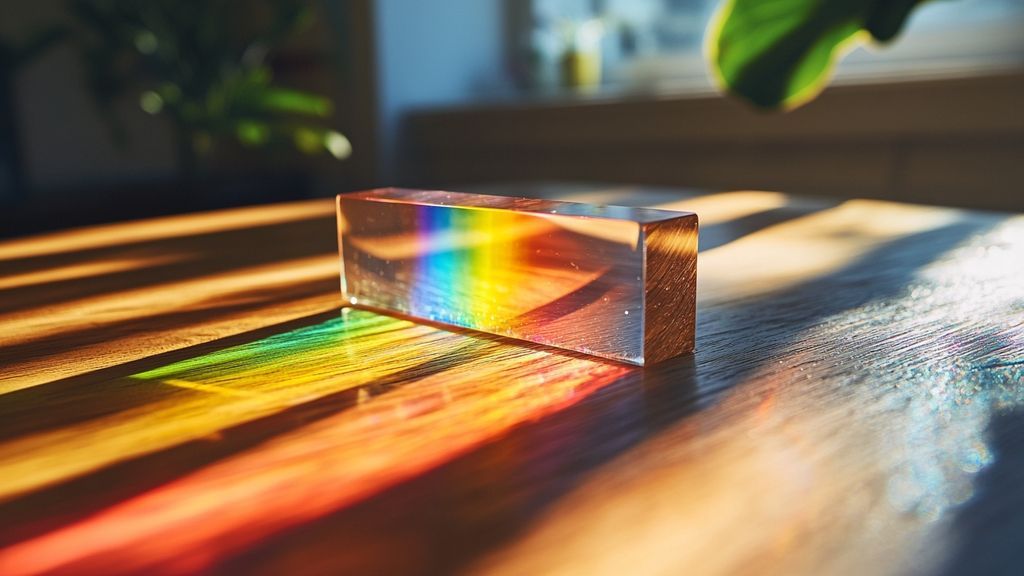
In a vacuum, light propagates at a speed of about 299,792 kilometers per second, a fundamental constant in physics. This speed is affected by the medium through which it travels, with a noticeable slowing down when it passes through materials like glass or water. This change in speed gives rise to refraction, which allows for phenomena such as image doubling when looking through a prism.
Applications of Light
The properties of light are used in a multitude of technological applications. For example, modern telecommunications rely on optical fibers, which exploit total reflection to transmit data at high speed. Moreover, light plays a crucial role in surveillance systems, medical devices, and energy production, particularly through solar panels.
Light and Color
Different wavelengths of light correspond to distinct colors. White light, indeed, is polychromatic, meaning it contains all the visible colors. When it interacts with an object, some wavelengths are absorbed while others are reflected, thus determining the color we perceive. For example, a red object absorbs all wavelengths except those corresponding to the red color.
Solar Energy and Its Effects
Understanding the properties of light is not merely theoretical; it has significant practical implications. Solar light, for instance, is a crucial renewable energy source for reducing our carbon footprint. Thanks to innovations in solar energy, we are able to integrate this clean resource into our habitats effectively. Solar panels convert sunlight into electricity, thereby enabling sustainable use of energy resources.
Conclusion and Future Perspectives
Light is a vast and multidimensional subject, with both theoretical and practical implications. As our understanding of this energy continues to evolve, efforts are underway to better grasp the subtleties of its properties and its interactions with our environment. This could lead to new innovations that will improve our quality of life while preserving our planet, thus attesting to the importance of research in physics. For more information on sustainable energy, also check the articles on how to reduce your carbon footprint and the impact of volcanoes on our environment.
Comparison of Light Aspects
| Aspect of Light | Concise Description |
| Nature | Light is a visible electromagnetic wave to the human eye. |
| Wavelength | Light waves are distinguished by their wavelength, influencing perceived color. |
| Propagation | Propagates in a vacuum at a speed of about 299,792 km/s. |
| Spectrum | White light is polychromatic, containing several colors. |
| Behavior | Both particle-like (photons) and wave-like depending on experiments. |
| Absorption | Colors absorb different wavelengths, influencing perceived color. |
| Thermal Emission | A hot object emits in the infrared, temperature thresholds affecting the emitted spectrum. |
As a physical phenomenon, light plays a vital role in our understanding of the world. This article examines the properties of light, its wave and particle nature, as well as its practical applications. Understanding light also involves grasping fundamental concepts such as wavelengths and how it interacts with matter.
Nature of Light
Light can be defined as a visible electromagnetic wave to the human eye, propagating at a speed of about 300,000 km/s in a vacuum. Its behavior is determined by two complementary aspects: that of a wave and that of a particle, represented by particles called photons. This duality makes light a fascinating subject of study in physics.
The Electromagnetic Spectrum
Visible light is only a small part of the electromagnetic spectrum, which also includes radio waves, infrared, ultraviolet, and many others. At the edge of the spectrum, red light has the longest wavelength (about 620-750 nm) and the lowest frequency, while violet light, at the other end, has a shorter wavelength and a higher frequency.
Properties of Light
Light exhibits several distinct properties, including reflection, refraction, diffraction, and absorption. Reflection occurs when light bounces off a surface, while refraction concerns the bending of light as it passes from one medium to another. Diffraction, on the other hand, is the spreading of waves when they encounter an obstacle or an opening.
Transformation of Light
It is also interesting to note that light can be transformed into heat when absorbed by objects. An object at 25 °C primarily emits in the infrared, but as the temperature increases, the emitted spectrum shifts to shorter wavelengths. Thus, at high temperatures, light can reach regions of the visible spectrum.
Applications of Light
The applications stemming from the understanding of light are vast. They encompass various fields such as photography, optics, and even modern technologies like solar panels. Understanding how to integrate solar energy into a sustainable habitat is crucial for an eco-responsible future, as can be discovered here: Integrating Solar Energy.
Studies and Research
The research on light is a constantly evolving field. For example, volcanoes play a crucial role in our ecosystem, and studying them reveals fascinating aspects of light and heat in the geological cycle. To learn more about the impact of volcanic eruptions, check out this article: Prediction and Consequences of Volcanic Eruptions and discover how these natural phenomena influence our environment.
- Nature of light: Electromagnetic waves perceptible to the human eye.
- Light particles: The photons, elementary and massless.
- Propagation: Light travels at a speed of about 299,792 km/s in a vacuum.
- Wavelengths: Ranges from red (high wavelength) to violet (low wavelength).
- White light: A mixture of all the colors of the visible spectrum.
- Absorption: Materials absorb certain wavelengths, producing visible colors.
- Thermal effect: Objects emit light according to their temperature.
- Frequency: Inversely proportional to wavelength, determines perceived color.
- Reflection: Light bounces off surfaces, creating images.
- Refraction: Change in direction of light when passing through different media.
Introduction to Light and Its Properties
Light is a natural phenomenon whose understanding is essential in physics. It manifests as electromagnetic waves, playing a crucial role in our visual perception and in many scientific processes. This article explores the various properties of light, as well as its applications and behavior as both a wave and particle.
What is Light?
Light is a form of energy that travels through a vacuum or across material mediums. It is characterized by its speed of about 299,792 kilometers per second in a vacuum. In physics, light is often analyzed through its behavior as an electromagnetic wave, but also as a particle, leading to the concept of wave-particle duality.
Electromagnetic Waves
Electromagnetic waves, which include visible light, propagate through space. They are composed of oscillating electric and magnetic fields that move perpendicularly to one another. Visible light represents a small part of the electromagnetic spectrum, which also includes radio waves, microwaves, infrared, ultraviolet, X-rays, and gamma rays.
Properties of Light
Wavelength and Frequency
Light can be characterized by its wavelength, which corresponds to the distance between two successive peaks of a wave. The wavelengths of visible colors range from red (about 700 nanometers) to violet (about 400 nanometers). Frequency is related to wavelength by the relationship: frequency = speed of light / wavelength. This means that red light has the longest wavelength and the lowest frequency, while violet light has the shortest wavelength and the highest frequency.
Propagation and Absorption
Light propagates in a straight line, but it can be reflected, refracted, or scattered when it encounters an obstacle. This interaction forms the basis of image formation in mirrors and lenses. Additionally, light can be absorbed by objects, transforming its energy into heat. For instance, an object at 25 °C emits radiation in the infrared, and the hotter the light source, the more its spectrum shifts to shorter wavelengths.
Applications of Light
Technology and Research
The properties of light are utilized in numerous technological applications, ranging from optical fibers to computer vision. In the field of research, experiments involving light allow for a better understanding of elementary particles and the workings of the universe. Devices such as telescopes and microscopes use light to explore the infinitely large and the infinitely small.
Scientific Outreach
It is essential to communicate the science of light to make its concepts accessible to the general public. Understanding light and its properties paves the way for a better comprehension of natural phenomena and technological advancements. Educational programs and online resources can contribute to this dissemination of knowledge.
FAQ about Light and Its Properties in Physics
What is light? Light is a form of visible electromagnetic energy to the human eye, propagating as particles called photons.
How does light propagate? Light travels through space as electromagnetic waves, without transporting matter, and it travels in a vacuum at a speed estimated at 299,792 km/s.
What are the different colors of light? White light, like that emitted by the sun, is polychromatic and contains a multitude of radiations, ranging from red light to violet light.
What are the fundamental properties of light? Light displays several properties, such as reflection, refraction, absorption, and it can behave both as a wave and as a particle.
How does temperature affect light? An object at 25 °C primarily emits in the infrared, and the hotter a body is, the more its light spectrum shifts towards shorter wavelengths.
Why does light have different wavelengths? Different wavelengths determine the color perceived by the human eye, with red light having the longest wavelength and violet light the shortest.
What is light absorption? Light absorption occurs when it penetrates a material and is converted into heat rather than being reflected or transmitted.
What is the role of photons in light? Photons are quanta of energy that make up light, each transporting a certain amount of energy related to its wavelength.