|
IN BRIEF
|
Using nature as a learning resource for mathematics paves the way for an innovative and stimulating pedagogical approach. By moving outside the classroom, students can observe and interact with their environment, which fosters contextualized learning. Mathematical concepts come to life through hands-on activities, making the learning process not only more dynamic but also more sustainable. By integrating natural elements, such as geometric shapes found in plants or the patterns of leaves, teachers can transform every outing into a rewarding experience, where students develop essential skills in problem-solving and modeling. Nature thus becomes a true open-air laboratory, conducive to exploration and discovery.
In an increasingly digitized world, it is essential to return to learning methods that utilize observation and interaction with the environment. Using nature as a learning resource for mathematics not only makes concepts more tangible but also engages students in activities that enhance their creativity and understanding. This article explores various approaches and pedagogical strategies for integrating nature into mathematics education.
The benefits of learning outdoors
Learning outdoors offers a multitude of advantages that enrich the educational experience. Firstly, it allows students to contextualize their learning. Instead of being limited to abstract exercises in class, learners can observe and interact with natural elements, fostering a deeper comprehension of mathematical concepts.
Improvement of problem-solving skills
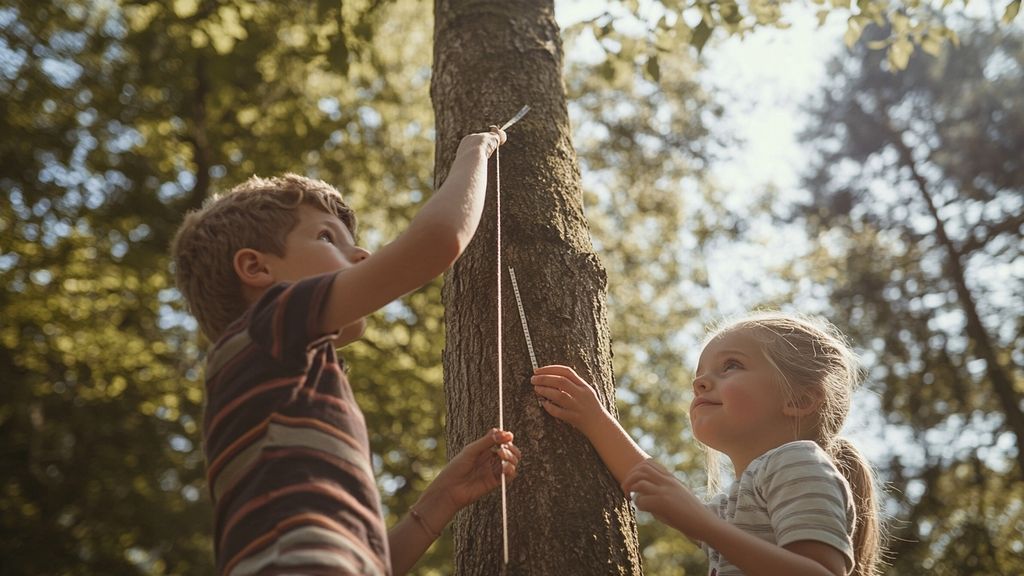
Learning in nature develops children’s ability to solve problems. By presenting students with tangible challenges, such as measuring the height of a tree using triangles or calculating the area of a garden, they are encouraged to apply mathematical concepts in a practical manner. This innovative approach also stimulates their logic and creativity.
Integration of mathematical concepts into nature
Nature offers an ideal backdrop for introducing a variety of mathematical concepts, ranging from geometry to statistical modeling. For example, students can explore the growth patterns of plants to approach concepts of symmetry and repetition. Similarly, observing the different shapes and angles in the landscape can illustrate geometric notions through playful activities.
Studying fractals and natural complexity
Fractals are an excellent example of the beauty and complexity found in nature. By studying these self-similar patterns, students can not only learn advanced mathematical concepts but also recognize the relationship between mathematics and the environment. For further exploration, you can consult resources on the analysis of fractals.
Hands-on activities for active learning
Hands-on activities play a key role in outdoor mathematics learning. Whether through educational games based on distance calculations or construction projects using natural elements, students are invited to participate actively. These experiences enhance their interest in mathematics while promoting better knowledge retention.
Using digital tools outdoors
Although outdoor learning is inherently connected to nature, integrating digital tools can enrich this experience. For instance, using measurement or calculation applications can facilitate data collection during activities. This allows students to learn how to manipulate and analyze information while remaining connected to their environment. Additionally, this fusion of nature and technology makes learning even more engaging.
Engaging students through dramatization
An interesting approach is to use nature as a stage for dramatized expressions to teach mathematics. By staging scenarios where they must solve mathematical problems, students develop their creativity and imagination. This method also promotes peer communication, which is essential in collaborative learning.
Implementation examples
Projects such as creating a mathematical garden, where each plant is associated with a specific mathematical concept, can inspire activities. Similarly, designing orienteering courses that incorporate mathematical challenges allows students to apply what they have learned in a stimulating and interactive setting.
Towards an enriched educational future
Mathematics, often perceived as a rigid discipline, can gain vitality through the integration of nature into its teaching. By making learning more concrete and vibrant, educators can hope for better knowledge retention and increased interest in mathematics. Furthermore, this approach fosters a deeper connection between students and their environment, a valuable skill in the face of contemporary ecological challenges.
It is essential to explore the interconnections between science and mathematics for a more holistic education. By developing this nature-based approach, we do not only appeal to mathematical tools but also to a broader visualization and understanding of our world. To deepen your knowledge in the fields of mathematics and science, consult resources such as the history of physics or the importance of prime numbers.
Using Nature for Learning Mathematics
| Learning axes | Examples of activities |
| Observation | Analyze patterns in leaves and flowers to introduce fractals. |
| Measurement | Measure the height of trees to practice perimeter calculations. |
| Modeling | Model natural phenomena using mathematical functions. |
| Geometry | Use the terrain to understand angles and geometric shapes. |
| Statistics | Collect data on local biodiversity to conduct statistical analyses. |
| Practical problems | Solve puzzles based on elements of nature. |
| Interdisciplinarity | Combine mathematics and natural sciences for educational projects. |
Teaching mathematics outdoors presents a unique opportunity to contextualize learning and ground it in the real world. Nature, often perceived merely as an observational framework, can become a true learning tool in mathematics. Innovative activities allow exploration of mathematical concepts while immersing oneself in an enriching natural environment.
Nature as a medium of expression
Nature offers a vast medium of expression for students, fostering both skill development and personal growth. By integrating natural elements into lessons, educators can encourage students to express their ideas creatively while learning fundamental mathematical notions. Outdoor activities allow students to actively engage, increasing their motivation and commitment.
Exploring geometric concepts
Geometry takes on a new dimension when students are prompted to observe the shapes, textures, and proportions present in nature. While strolling through a park or forest, they can identify geometric figures and discover patterns, thereby enhancing their understanding of geometry in an interactive manner. Hands-on activities, such as measuring natural objects, further reinforce learning.
Outdoor mathematical activities
To make learning mathematics dynamic, several activities can be implemented. For example, students can participate in mathematical treasure hunts, where each step requires calculating a distance or solving a math-related riddle. Using natural elements such as sticks, stones, or leaves allows for the illustration of mathematical concepts in a tangible and engaging way.
The benefits of outdoor learning
Research shows that learning in nature enhances children’s ability to solve problems and master both mathematical and scientific concepts. By spending time outdoors, students can concentrate better, thereby improving their memory and comprehension of the topics covered. Outdoor education also fosters a closer connection with the environment, cultivating both academic and practical know-how.
Fostering a connection with nature
Using nature as a learning resource extends beyond mathematics, fostering a stronger connection to our environment. This bond helps students understand the importance of preserving nature, while also developing critical thinking skills. By integrating these learnings into everyday life, educators prepare students to become responsible citizens aware of environmental issues.
- Observation of shapes: Study the geometries of leaves and flowers to understand concepts of symmetry and proportion.
- Direct measurement: Use a measuring tape to analyze plant growth and calculate garden areas.
- Natural modeling: Create mathematical models based on the life cycles of species.
- Mathematics of the seasons: Analyze climatic variations and their impact on plant growth cycles.
- Games and activities: Design mathematical treasure hunts in nature to solve problems.
- Fractals: Study growth patterns of trees and ferns to introduce the concept of fractals.
- Natural statistics: Collect data on biodiversity and analyze it to draw conclusions.
- Mathematical circuit: Create outdoor paths that incorporate mathematical challenges to solve during the walk.
- Utilization of ecosystems: Explore how natural resources can be modeled as complex systems.
- Art and mathematics: Use natural elements to create artworks illustrating mathematical concepts.
Using nature as a learning resource for mathematics is an innovative and engaging method that allows students to integrate mathematical concepts into their environment. By placing students in direct contact with the natural world, they can better visualize and understand concepts that can sometimes be abstract. This article presents recommendations for integrating nature into mathematics education, making learning more concrete and sustainable.
The benefits of learning outdoors
Learning outside offers numerous advantages. When students are exposed to the natural environment, they develop a keen sense of observation. Outdoor activities allow them to explore and experiment, facilitating the learning of mathematics through concrete contexts. By integrating nature into learning, students also improve their problem-solving skills, as they are faced with real situations that require critical thinking.
Examples of outdoor activities
There are many fun activities that allow for the integration of mathematics and nature. For example, measuring the height of a tree using the principle of similar triangles or calculating the circumference of a stump using geometry. Other suggestions include counting games using natural elements, such as leaves or stones, or creating mosaics with natural elements to illustrate concepts of symmetry.
Developing a pedagogy towards nature
To effectively integrate nature into mathematics classes, it is essential to develop a tailored pedagogy. Teachers can design lesson sequences that rely on lived experience. For example, a school trip to the forest could be an opportunity to practice area and volume calculations using elements from the landscape, such as cabins or vegetation zones. This helps to make mathematics more tangible.
Creating a stimulating learning environment
An engaging environment is crucial for helping students feel comfortable exploring and learning. Organizing math challenges in groups in outdoor spaces can encourage cooperation and the exchange of ideas. For instance, students can work together to create geometric maps based on their own perception of the surrounding space, thereby reinforcing their understanding of mathematical concepts in a collaborative way.
Using natural elements to teach mathematical concepts
Nature offers a multitude of elements to teach various mathematical concepts. The fractals observed in the patterns of leaves or snowflakes can be used to introduce notions of geometry and symmetry. Similarly, observing seasonal patterns in the behavior of animals or plants can help explain number series and proportions.
Sharing and narrating experiences
It is important for students to share their experiences and discoveries. Organizing discussion sessions after outdoor activities helps reinforce learning. Students can recount what they observed and how they applied mathematical concepts to their discoveries, allowing them to reflect on the learning process while developing communication skills.
FAQ: Using nature as a learning resource for mathematics
Q: How can nature help in learning mathematics? Nature provides a stimulating environment where students can observe and apply mathematical concepts concretely. By using natural elements, students can better contextualize their learning.
Q: What types of activities can be performed outdoors to teach math? Activities such as mathematical treasure hunts, geometric shape constructions using sticks, or measuring trees can be implemented. Physical engagement and exploration promote learning.
Q: How can geometry be taught outdoors? Natural elements can be used to teach geometry, for instance by asking students to trace shapes with stones or discover angles by observing trees and landscapes.
Q: What is the impact of outdoor learning on students? Outdoor learning allows students to develop their problem-solving skills, improve their understanding of mathematical concepts, and increase their motivation to learn.
Q: Is it possible to integrate other subjects with mathematics during outdoor activities? Absolutely. Nature can also serve as a resource for teaching science, language, and even arts, fostering the integration of multiple disciplines.
Q: What is the best approach to start teaching mathematics outdoors? It is recommended to begin with simple activities that engage students and offer them the opportunity to explore. Gradually, more complex concepts can be introduced.
Q: What tools or materials are necessary for teaching math outdoors? Few tools are necessary; just natural materials, notebooks for taking observations, and sometimes measuring equipment like measuring tapes.