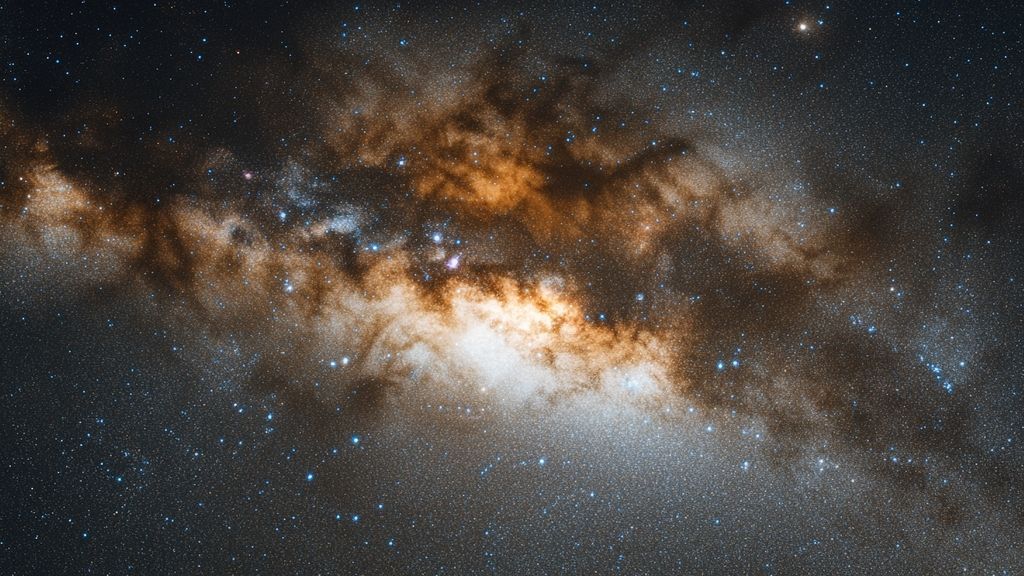
The star formation complexes

Stellar formation complexes represent one of the most fascinating and dynamic astrophysical phenomena in our universe. These vast cosmic regions house dense molecular clouds where stars are born, giving rise to star clusters and protostars. This process of gravitational collapse and formation is often accompanied by infrared emissions characterizing the protoplanetary disks where future planetary … Read more

Gamma bursts: understanding the most energetic explosions

Gamma-ray bursts represent the most violent and energetic phenomena observed so far in the Universe. These energy explosions, intermittently appearing in the cosmic night for billions of years, release a colossal amount of energy in just a few seconds, often greater than that emitted by the Sun over its entire lifetime. Lasting from a few … Read more

Pulsars and their functioning

Les pulsars et leur fonctionnement

IN BRIEF Pulsar: a dense neutron star rotating rapidly Emits electromagnetic radiation like a beacon Radiation linked to its magnetic field and rotation Beam of radio waves sweeps space Interval between pulses varies, typically per second Pulsars can exist in binary systems Ability to recycle itself by absorbing mass from a companion star Gamma pulsars … Read more

Nucleosynthesis of elements in stars

La nucléosynthèse des éléments dans les étoiles

IN SHORT Stellar nucleosynthesis: A set of nuclear reactions occurring inside stars. Creation of chemical elements: Massive stars generate heavy elements through nuclear reactions. Star formation: They form from clouds of gas rich in hydrogen and helium. Primordial nucleosynthesis: Formation of light elements during the origin of the Universe. Types of nucleosynthesis: Includes stellar, primordial, … Read more

The properties of white dwarfs

Les propriétés des naines blanches

IN BRIEF Mass: between 0.3 and 1.4 times that of the Sun Volume: similar to that of the Earth Density: very high, resulting in intense gravitational forces Mass-size relation: the greater the mass, the smaller the size Electrons: exert a dominant quantum pressure within these celestial bodies Compactness: makes these celestial bodies sensitive to gravitational … Read more

The different phases of a star’s life

Les différentes phases de la vie d'une étoile

IN SHORT Birth: Formation of a star from a nebula. Main sequence phase: Stabilization and fusion of hydrogen into helium. Red giant: Expansion as hydrogen depletes, the star becomes a red giant. Variable end: Depending on its mass, it can become a white dwarf or explode into a supernova. To die: Results in a supernova … Read more

Understanding star formation

Comprendre la formation des étoiles

IN BRIEF Star formation: Formation from the gravitational contraction of a nebula. Protostars: Clouds of gas that continue to contract to develop a star. Composition: Balls of gas mainly composed of hydrogen and helium. Process: Gravitational collapse of interstellar clouds. Stellar evolution: Life cycle encompassing the birth, evolution, and death of stars. Ongoing formation: About … Read more